The same visitor, worldwide
People who have never met report the identical figure. A tall, shadowy man in a wide-brimmed hat, often a fedora, standing silent in the dark.
He does not speak or approach. He watches from the corner or the foot of the bed. In his presence, witnesses report a suffocating sense of dread.
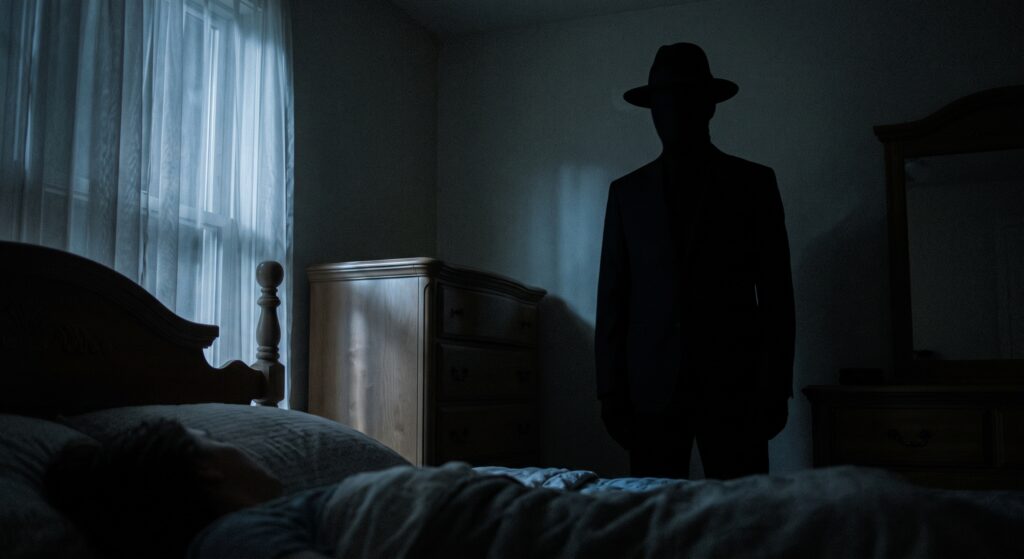
The consistency is the mystery. How do isolated strangers across continents conjure the same character? Neuroscience has a compelling answer.
It starts with sleep paralysis
Most Hat-Man encounters happen during sleep paralysis. This occurs in the gap between REM sleep and full waking. For more on sleep paralysis, click here.
During REM, your brain paralyzes your body so you do not act out dreams. Sometimes you wake while that paralysis lingers. You are conscious, immobile, and still generating dream imagery.
In that state, the brain projects vivid figures into the real room. You can see the actual furniture and, standing among it, something that should not be there.
The economizing brain
Why a faceless man in a hat, specifically? Harvard researcher Baland Jalal points to how the brain builds a threat under stress.
The brain uses shortcuts, filling incomplete visual data with the minimum needed to register danger. It renders just enough of a person, a tall dark silhouette, to justify the fear, without wasting effort on a face.
That explains why shadow people are almost always featureless, dark, and tall. The hat may be your brain incorporating a real bedroom object, like a coat rack or a hat on a door hook.
Culture loads the template
The cross-cultural match has a name: cultural priming. Once a shared image exists, the brain reaches for it during the next episode.
The internet supercharged this. A dedicated Hat Man project launched in 2008, and millions realized they shared the vision. Now people who read about him are primed to render him.
One eerie footnote supports the brain-based theory. People in anticholinergic delirium, caused by dangerously high doses of certain medications, report seeing the same figure. Two different brain states, one hat. If you have seen him, take comfort: he is terrifying, but he is not real, and you are far from alone.
References & Further Reading
IFLScience, Reports of the Hatman are surprisingly widespread
The Conversation and Jalal research on sleep paralysis imagery