You smell it before you see it. Rotten eggs. Wet dog. A stench so foul it can turn your stomach from fifty yards away. Then the palmettos shudder, and something seven feet tall stares back through the trees.
That is the legend, anyway. Florida’s swamps have bred some of the strangest monster stories in America. Here is the problem: half of what you have read about Florida’s cryptids is wrong. Not the fun kind of wrong either. The kind that erases real history and hands you a garbled myth instead.
So let us do this properly. Below you will find the state’s most famous swamp creatures and the verified record behind each one. Some of these beasts have deep roots. One of them was literally patented as a joke. Stick around, because the last few are the ones nobody explains correctly.
The Florida Skunk Ape: Bigfoot’s Smellier Cousin
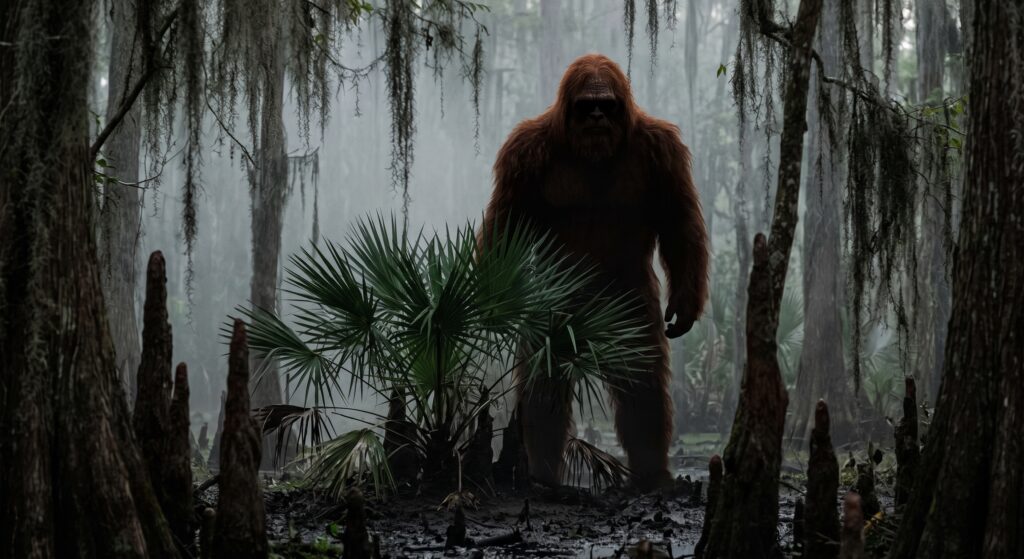
Start with the state’s signature monster. The Skunk Ape stands roughly seven feet tall, wears shaggy reddish-brown hair, and reportedly weighs 400 to 500 pounds. Witnesses describe a sulfurous reek of swamp gas, rotten eggs, and wet fur that clings to everything nearby.
That smell separates it from its northern relatives. People compare Bigfoot to a quiet forest ghost. The Skunk Ape announces itself through your nose first.
Here is where most accounts stumble. They claim the Seminole and Miccosukee tribes named the creature “Esti Capcaki,” meaning “Tall Man,” and passed the legend down for centuries. It reads beautifully. It also rests on shaky ground.
Wikipedia and several folklore researchers flag that attribution as an unsubstantiated cryptozoological claim, not a documented tribal tradition. The name circulates widely online, yet solid primary sources tying it to actual Seminole oral history stay frustratingly thin. Respect for living cultures means saying that plainly. We present the Esti Capcaki connection as a popular claim, not a settled fact.
The earliest “sighting” people cite comes from an 1818 newspaper report of a “man-sized monkey” raiding food stores and stalking fishermen. Some writers place that event in Apalachicola, Florida. Others trace the same story to Arkansas. The record genuinely varies, so please approach that origin date with caution.
Why Skunk Ape Sightings Exploded in the 1970s
Sighting reports spiked hard during the 1970s, and the reason tells you more than the reports themselves.
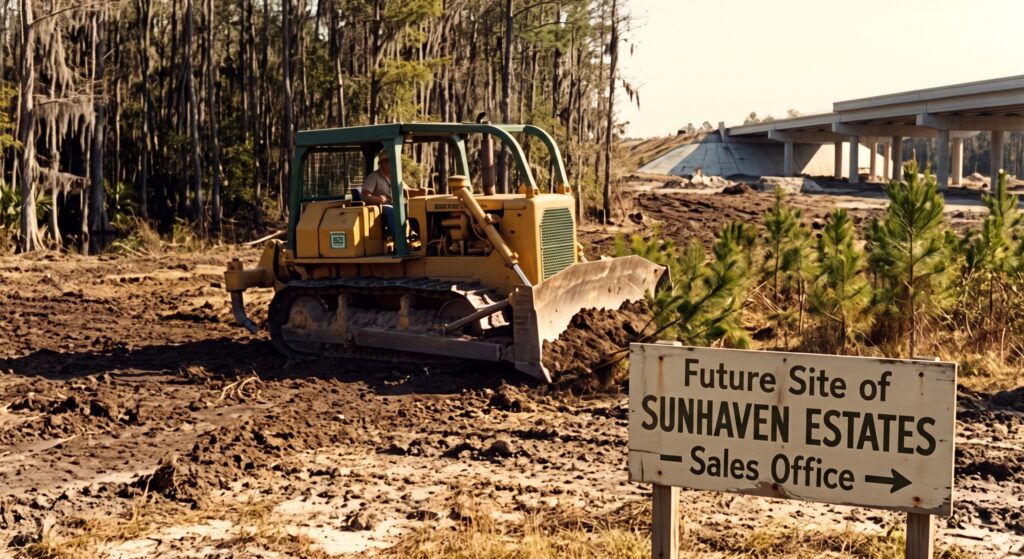
That decade brought aggressive real estate expansion, wetland draining, and new highway construction straight through the Everglades. Interstate 75 sliced the wetlands in two. If a large animal did roam that territory, bulldozers just cut its range in half and pushed it toward the suburbs.
Sightings also cluster during the dry season. Interior brush fires drive swamp wildlife toward outer canals in search of water. A frightened animal near a fresh subdivision makes for a memorable encounter.
You do not need to believe in a hidden primate to regard the phenomenon as this interesting. The pattern maps neatly onto human development. The monster surge coincides exactly with the moment we paved its home.
The Skunk Ape’s Most Famous Encounters
A handful of encounters built the modern legend, and they deserve accurate retelling.
In 1974, motorist Richard Lee Smith struck a large hairy figure with his car near Pembroke Pines. Hours later, a Hialeah Gardens officer reportedly spotted a limping creature before it vanished into brush.
The 1997 Big Cypress case gave the legend its crowd of witnesses. Tour guide Steve Goodbread and dozens of passengers watched a seven-foot biped shake palmetto bushes for several minutes. Within days, a real estate agent and a local fire chief separately photographed a similar figure crossing a nearby road.
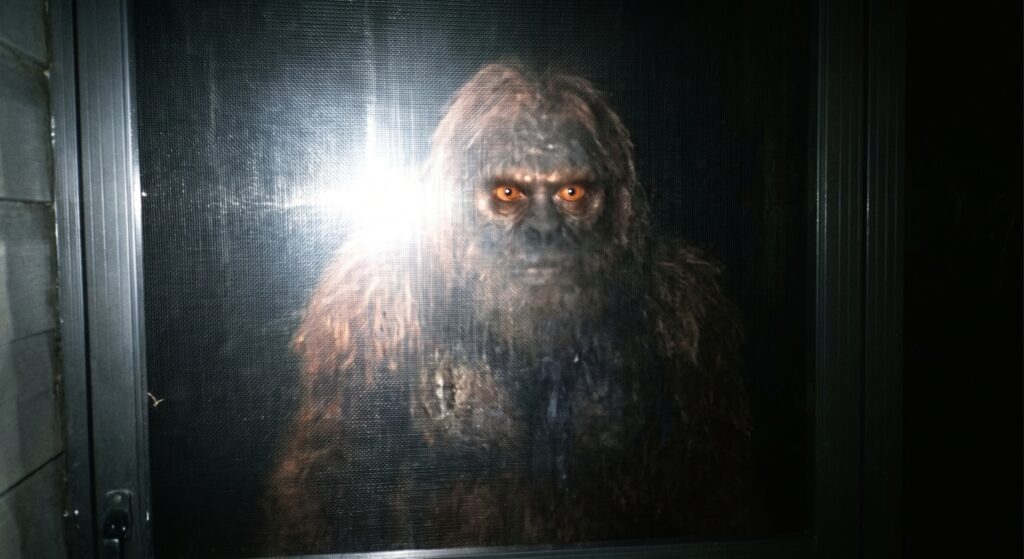
Then came the December 2000 “Myakka Skunk Ape.” An anonymous homeowner near Myakka River State Park snapped two flash photographs. The subject was a shaggy, orange-furred primate with glowing eyes. She claimed it crept onto her porch three nights running to steal apples. Those images remain the most debated Skunk Ape photos ever taken.
Skeptics note a tidy alternative. The average orangutan stands barely four and a half feet tall and weighs under 200 pounds, so escaped-circus-ape theories struggle to explain seven-foot giants. The mystery holds either way.
The Snoligoster: A Monster Invented in 1910
Now for the creature that exposes how these lists get made. The Snoligoster supposedly lurks around Lake Okeechobee. Storytellers describe a long, crocodilian, fur-covered beast with a spike on its back and a spinning, propeller-like tail.
The legend claims it hunts humans. It clubs victims with that tail, skewers them on its dorsal spike for storage, then drills a hole in the ground and grinds them into pulp. Grim stuff.
Here is the twist nobody mentions. The Snoligoster is not part of organic Florida folklore at all. It comes from a single 1910 book, “Fearsome Creatures of the Lumberwoods” by William T. Cox.
That book was a deliberate work of comic fiction. Cox collected and invented tall tales from logging camps, assigned each beast a fake Latin name, and presented the whole menagerie like a straight-faced field guide. Scholars classify it as metafiction. The Snoligoster shares that page with the Squonk and the Hidebehind, both openly fictional.
One folklore researcher even suspects Cox recycled the Snallygaster, a separate legend, when he built this one. So when a roundup calls the Snoligoster an ancient swamp terror, it is repeating a century-old literary prank as history. We flag it because the original Cox passage also contained racist content, and honest folklore means naming the source, not laundering it.
The Wampus Cat: A Cherokee Legend That Wandered South
You will find the Wampus Cat on nearly every Florida cryptid list, usually pinned to the oak hammocks near Lakeland. A six-legged panther with a nine-foot tail and glowing yellow eyes makes a striking entry. It also belongs somewhere else.
The Wampus Cat is fundamentally an Appalachian creature rooted in Cherokee mythology. Its home ground sits in East Tennessee and western North Carolina, not on the Florida peninsula. Occasional Florida reports exist, yet calling it a native swamp cryptid stretches the truth.
The best-known origin story follows a Cherokee woman named Running Deer. She sought revenge on Ew’ah, the Spirit of Madness, a demon that drove her husband insane. Armed with a bobcat mask charged with mountain-cat magic, she ambushed the demon by a stream and turned its power back on itself. Her people named her Spirit-Talker and Home-Protector.
Folklorists add a sharper wrinkle. The word “wampus” likely descends from “catawampus,” old American slang for something crooked or askew. Several early references use “wampus cat” to mean a vague bogeyman, not a specific beast. The Cherokee framing and the slang almost certainly blended over time.
This creature earns its full deep dive, and we link one here. Its story runs far deeper than a single line in a Florida list can hold.
The Muck Monster: How a Ripple Became a Celebrity
Some legends are born on video. In August 2009, volunteers from a nonprofit called Lagoon Keepers approached what looked like a floating log in the Lake Worth Lagoon. Every time their boat closed in, the “log” dove and slipped away.
Greg Reynolds and Dan Serrano filmed the chase. Serrano dubbed it the “elusive Muck Monster,” and the clip went viral. It racked up millions of views and reached David Letterman’s Top Ten list and the History Channel.
Correct the record here too. The marine biologist who reviewed the footage was Thomas Reinert of the Florida Fish and Wildlife Conservation Commission, and he simply could not identify the shape. The official who leaned into the fun was Mayor Lois Frankel, who playfully embraced the creature as a local mascot.
One detail deflates the mystery a little. The Lake Worth Lagoon is not a remote deep swamp. It is an urban, brackish coastal lagoon linked to the Atlantic, teeming with rays, tarpon, manatees, and other large animals that could easily produce a shadowy wake. The Muck Monster may be less monster than misread marine life. The town kept the legend anyway.
The Swamp’s Lesser-Known Oddities
Beyond the headliners, Florida’s wetlands hide a bench of stranger, murkier legends.
The Moss Man supposedly stalks North Florida and the Ocala National Forest. Reports since the 1800s describe a bipedal figure draped entirely in Spanish moss, blending into lakeside trees to vanish on command.
The Squallies haunt the outskirts of East Naples, specifically the half-built Golden Gate Estates. Local lore describes short, pig-snouted humanoids living in a hidden compound. Some versions blame a government experiment; others blame a reclusive scientist. The tale closely mirrors “Pig Man” legends worldwide, which suggests a traveling urban myth rather than a real population.
The Mahamba is the tall tale of the bunch. Storytellers claim a 50-to-60-foot prehistoric crocodile roams the deepest swamp systems, with a few insisting it is a surviving marine reptile. No credible evidence supports it, and Florida’s largest verified crocodilians top out far smaller.
Why These Legends Refuse to Die
Step back and a pattern emerges. Florida offers the perfect stage for monsters. Vast wetlands. Dense mangroves. Millions of acres a person could hide in for a lifetime. When development crashes into that wilderness, the encounters follow.
Notice what actually keeps these stories alive. It is rarely the most compelling evidence. It is us. We name a nipple, sell the T-shirt, and mount a telescope for tourists. We repeat a 1910 joke until it feels ancient. We borrow a mountain cat from the Cherokee and drop it in a Florida swamp.
That is the real value in looking closer. You lose nothing by learning that the Snoligoster came from a book or that the Muck Monster was probably a tarpon. You gain a sharper eye and a better story to tell at the campfire.
For more on this topic, see our complete guide to the Cryptids of North America: A Field Guide to Regional Monster Legends.
References & Further Reading
The Skunk Ape – Florida’s Bigfoot (WestPalmBeach.com)
Untangling the Truth About the Skunk Ape (All That’s Interesting)
Florida Skunk Ape Sighting Tracker (WKMG ClickOrlando)
Fearsome Creatures of the Lumberwoods, 1910 (Wikisource)
Fearsome Critters (A Book of Creatures)
‘Muck Monster’ Legend Becomes Part of Our History (PBC History)
Muck Monster a Mystery in Florida Lagoon (WMBF News)
Florida Cryptids and Folklore (Folk Bestiary)