On October 5, 1967, newspapers across the country ran a story that would go on to shape decades of UFO folklore: a horse in Colorado’s San Luis Valley had been found dead and mysteriously mutilated, and how it died convinced plenty of people that flying saucers were responsible.
A death on the Harry King Ranch
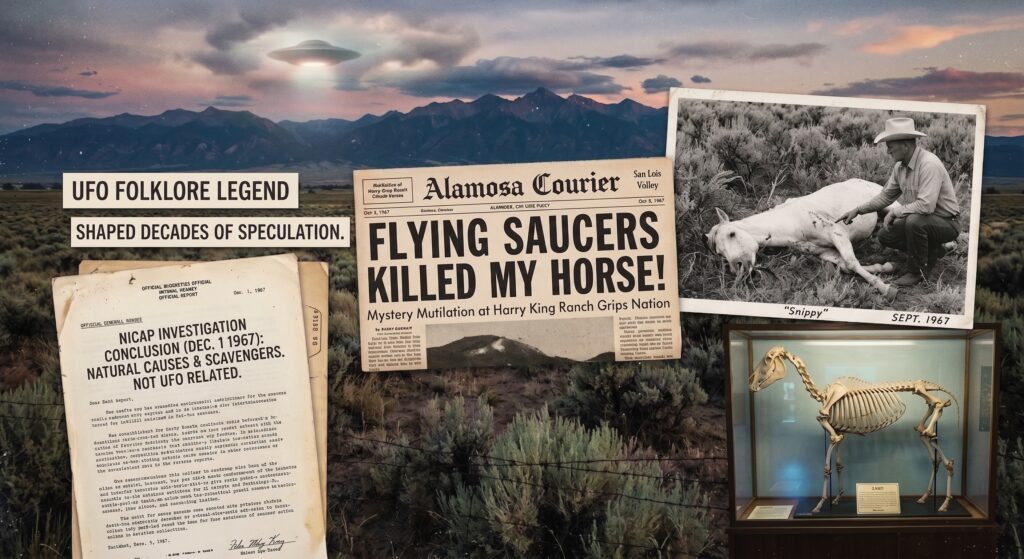
The horse at the center of the story was stabled at the Harry King Ranch near Alamosa, in the heart of the San Luis Valley. At the time, coverage referred to the mutilated horse as “Snippy,” but later research revealed that her actual name was Lady—Snippy was her sire, and the names seem to have become confused somewhere between the ranch and the press. Lady failed to return for her usual evening drink on September 7, prompting a search that turned up her body under circumstances strange enough to make national news.
“Flying Saucers Killed My Horse!”
Sensationalized coverage ran with headlines like “Flying Saucers Killed My Horse!” and the story spread nationally, becoming the first widely publicized case to connect an animal’s mysterious death with UFOs—effectively originating the entire genre of “cattle mutilation” folklore that would go on to produce hundreds of similar reports across the American West in the decades that followed. Alongside the extraterrestrial theory, speculation at the time also floated satanic cult activity and covert government or intelligence operations as possible explanations, reflecting just how eager the press and public were to find something extraordinary behind an animal’s death.
What investigators actually found
The more grounded assessments told a much less dramatic story. Mainstream veterinary and scientific opinion concluded the horse’s death was most likely the result of natural causes and ordinary scavenger activity after death, rather than anything deliberate or supernatural. By December 1, 1967 — less than three months after the story broke — civilian UFO researchers with the National Investigations Committee on Aerial Phenomena had reviewed the case and concluded publicly that it was “neither a UFO case nor particularly mysterious.”
A legend that outlived the investigation
Despite that fairly definitive conclusion from researchers who were themselves inclined to take UFO claims seriously, the Snippy story never really faded from Colorado folklore. If anything, it became a foundational case—the origin point that later cattle mutilation reports across the region would implicitly reference, whether or not anyone still remembered the details of the original 1967 case. The horse’s skeleton was preserved and passed between owners for decades before landing, in 2021, at the UFO Watchtower—a small roadside tourist attraction in the San Luis Valley built specifically around the region’s reputation for unexplained phenomena, where Snippy’s remains are now on public display.
Why it still matters
Snippy’s story endures not because the mystery holds up under scrutiny — investigators reached a fairly mundane conclusion within months — but because it captured something the San Luis Valley has never quite shaken: the sense that its wide-open, sparsely populated landscape is precisely the kind of place where something unexplainable could happen. More than fifty-five years later, a horse that most likely died of natural causes remains one of the founding legends of American UFO culture and a permanent fixture of one of Colorado’s strangest regions.