Cheesman Park is one of Denver’s most photographed green spaces—a rolling lawn framed by the Denver Botanic Gardens and a marble pavilion with a postcard view of the Rockies. It’s also, by the city’s own admission, a graveyard. It’s not a former graveyard whose bodies were all relocated. A graveyard that was simply built over, with thousands of its residents left exactly where they were buried.
A cemetery nobody wanted
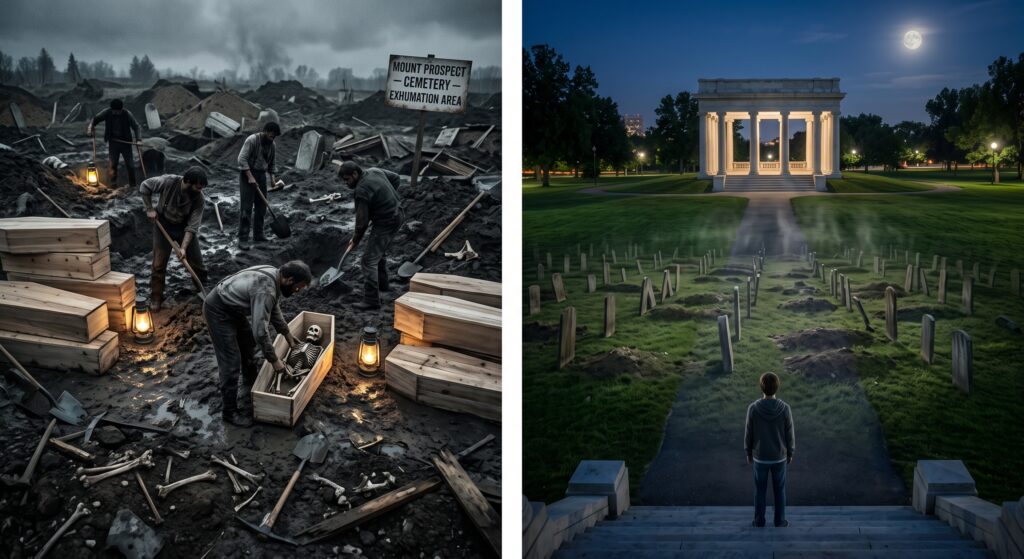
The land started as Mount Prospect Cemetery in 1858, set aside by General William Larimer on 280 acres east of downtown. From the start it had a reputation as Denver’s least desirable burial ground—a place for the poor, the friendless, and the condemned. Records from 1866 counted 626 burials, a number that would climb into the thousands over the following decades as the city’s indigent, its smallpox victims, and its executed criminals were interred there with little ceremony.
By the 1890s, Denver wanted the land back. In 1890, Congress authorized converting the cemetery into a public park, and the city gave families ninety days to claim their dead and pay for reburial elsewhere. It was a narrow window for a 32-year-old cemetery full of transient miners, unclaimed paupers, and forgotten families, and predictably, most of the dead went unclaimed.
The ghoul with a contract
To clear what remained, the city hired a local undertaker named E.P. McGovern in 1893 under a grim piece-rate contract: a fresh coffin and $1.90 for every body he exhumed and relocated to Riverside Cemetery. McGovern, doing the math on volume rather than dignity, realized he could move faster and profit more by cutting up adult remains and packing the pieces into child-sized coffins—squeezing what should have been one burial into three billable ones.
The results were exactly as horrifying as they sound. Workers left body parts scattered across the disturbed ground, and when a reporter from the Denver Republican got wind of it, the paper ran the story under the header “The Work of Ghouls.” Public outrage was immediate. Denver’s mayor canceled McGovern’s contract immediately, but the cleanup was never finished. Historians estimate that anywhere from a few hundred to several thousand bodies were never moved at all—they’re still there, a few feet beneath the picnic blankets and frisbee games of modern Cheesman Park.
What people say they’ve seen
The neighborhood around the park absorbed the scandal into its folklore almost immediately. Residents of the Victorian homes bordering the park reported confused, disoriented apparitions in the years after the exhumation — figures who seemed lost, knocking on doors that weren’t theirs, or peering in through windows as if searching for a home that no longer existed. Locals nicknamed one recurring figure “Slackjaw,” described as a gaunt man with a hollow, sagging face who appears near the park’s edges after dark.
The stories haven’t stayed in the past. Modern visitors describe a specific, oddly consistent phenomenon: lying down on the grass in certain parts of the park and being unable to get back up right away, as though pinned by an invisible weight, before the sensation passes as suddenly as it arrived. Others describe a heaviness or dread that settles in without explanation, concentrated around the pavilion and the park’s older, western edge—reportedly the same ground where the historic cemetery’s least-visited paupers’ graves once sat.
There’s a specific piece of local lore attached to the pavilion itself: stand on its west steps on a moonlit night, the story goes, and for a moment you won’t see the park’s rose gardens and jogging paths at all—you’ll see the cemetery as it was, densely packed with wooden markers and turned earth, before the illusion dissolves back into the present.
Why it still resonates
haunted hotel What makes Cheesman Park different from a typical haunted-hotel story is that the horror isn’t really supernatural in origin—it’s historical and, frankly, bureaucratic. The ghost story exists because of a real scandal: a city that wanted its unpleasant history erased quickly and cheaply, and a contractor who found a profit motive in doing it badly. The hauntings, whether you take them literally or as folklore, serve as a kind of collective memory for a wrong that the city never fully corrected. Denver never finished moving the bodies, and in a sense, the park has never let the city forget it.
Today Cheesman Park draws dog walkers, wedding photographers, and Fourth of July fireworks crowds who mostly have no idea they’re standing on unmarked graves. For those who do know the history, an evening walk near the pavilion tends to feel different—less like a stroll through a park and more like a stroll through the unfinished business of Denver’s early years.
[…] miners brought their ghosts—the Tommyknockers—and the Vampire of Lafayette. while Denver built Cheesman Park directly over a cemetery. The Stanley Hotel in Estes Park remains one of the most famous haunted […]