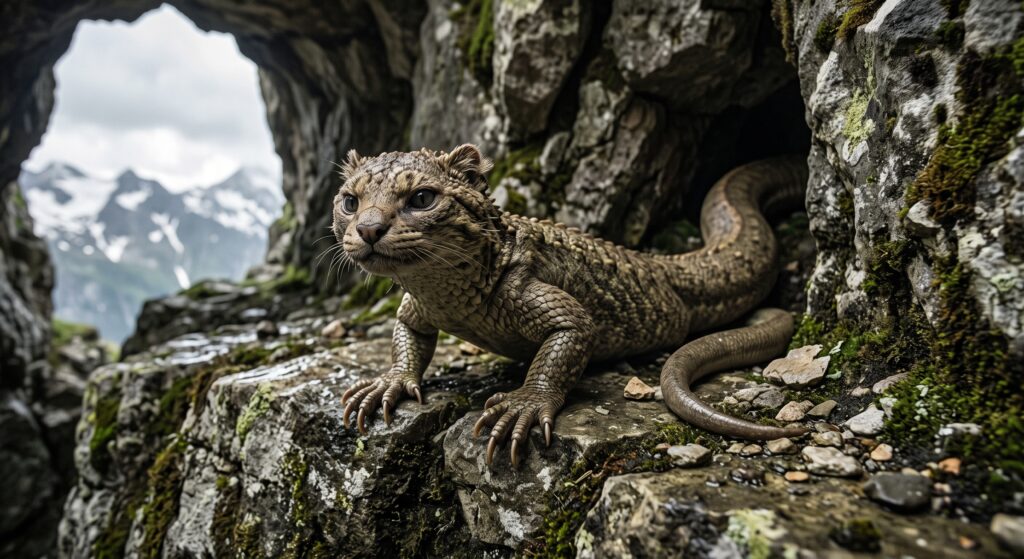
The name “Tatzelwurm” comes from two German words: “Tatze,” meaning “paw” or “claw,” and “Wurm,” meaning “worm” or “serpent.” Reports describe a stubby, bipedal creature, usually 2 to 6 feet long, with clawed front limbs, no visible hind legs, and a blunt, cat-like head. Some accounts lean toward a chunky lizard. Others describe something closer to a small, wingless dragon.
Two Centuries of Claw Marks
The earliest documented Tatzelwurm encounter dates to 1779, when two of the creatures reportedly confronted a man named Hans Fuchs. In 1828, a peasant claimed to find a Tatzelwurm corpse. Crows had eaten half of it before he could bring the body home for examination.
A Bavarian hunting manual from 1836 included one of the earliest illustrations of the creature. Nearly a century later, in 1934, a Swiss photographer named Balkin claimed to have captured a Tatzelwurm on film near a fallen log. That photo drew enough attention that the Berliner Illustrierte sponsored an expedition to find one. The expedition came back empty-handed, and public interest cooled almost immediately after.
What a Real Survivor Would Need
Fringe cryptozoologists argue the Tatzelwurm descends from a relic amphibian or from a specialized bipedal lizard that dodged the Mesozoic extinction. In this telling, it survived by retreating into high-altitude caverns. That claim requires a cold-blooded reptile to thrive at altitudes and temperatures that exceed the limits of most reptile physiology. That is a demanding expectation, especially without a fossil trail to support it.
Mainstream zoologists point instead to animals already living in those crevices. European badgers, feral cats, and alpine salamanders all fit the profile. Some fire salamanders grow large enough to startle a hiker glimpsing one from a bad angle in poor light.
Regional Names, Same Shape
The creature carries several regional names, including Stollenwurm, Springwurm, Arassas, and Bergstutzen, according to the Encyclopedia of Cryptozoology. Sightings stretch across France, Italy, and Spain. Austria and Switzerland still account for the bulk of reports across the centuries.
German researcher Ulrich Magin has kept the tradition documented in recent decades. He has cataloged sightings in Fortean Times and in his own publications. The Tatzelwurm never became a global brand like Nessie. It has still quietly outlasted plenty of louder legends, one alpine crevice at a time.



[…] the high mountains, a different kind of predator lurks. The Alpine Tatzelwurm is a thick, snake-like lizard with the face of a cat, feared by generations of Swiss and Austrian […]