Listen closely inside the Woodrow Wilson House and you may hear it. A slow, rhythmic tap climbs the main staircase, pauses, and continues. Tap. Tap. Tap.
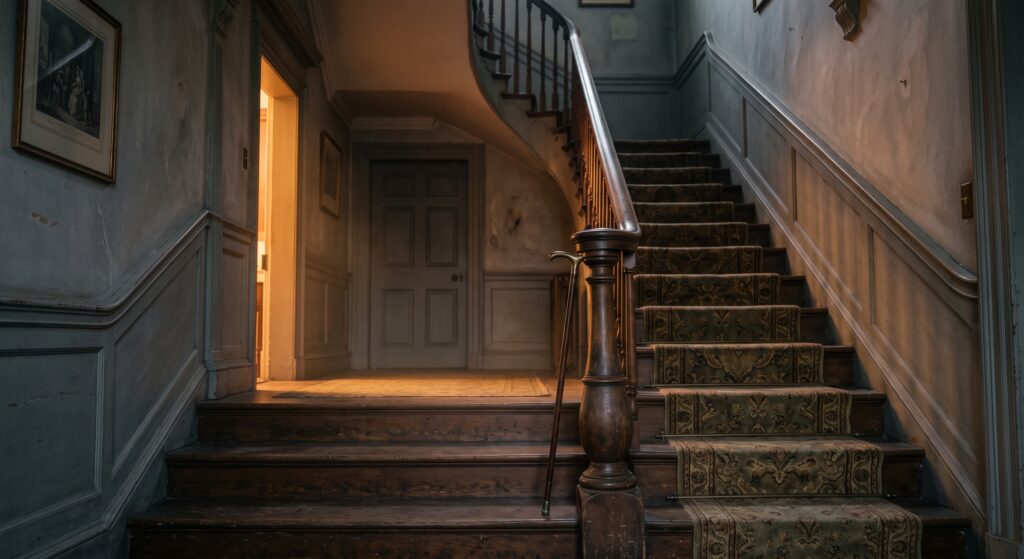
It sounds like a man walking with a cane, one careful step at a time. Staff have reported the noise for decades in a house where no living person is climbing the stairs.
Many storytellers call this the most haunted home in the capital. The president who died here left behind a grief so complete that people say it still moves through the rooms.
This is not a tale of vengeance or violence. It is a tale of a brilliant man who ran out of time, and the sorrow he may have left on the stairs.
The Stroke and the Shattered Dreams
Woodrow Wilson led the nation through World War I and staked his legacy on the League of Nations. He believed the world could bind itself to lasting peace. He gave everything to that vision.
Then his body betrayed him. A severe stroke in 1919 left him partially paralyzed while he still held office. His inner circle hid the full extent of his disability from the public, and his wife Edith managed much of his daily correspondence.
He left the presidency in 1921 and moved to a Georgian Revival townhouse on S Street, just off Embassy Row. He arrived with plans. He wanted to recover his strength, open a law practice, and return to the scholarly writing he loved.
None of it happened. His health kept failing, and his dream for the League died in a hostile Senate. The world moved on without the peace he had promised.
He lived out his final years as a despondent patient, tended by Edith in the quiet house. He died in his bedroom in February 1924. He remains the only president buried within Washington, D.C.
The Cane, the Sobbing, and the Silent Piano
The phantom cane is the signature haunting, but it is not the only one. Caretakers have reported the sound of a man sobbing from the direction of the former bedroom, a grief that seems to rise from nowhere and fade into nothing.
Visitors describe a figure in the study. A pale, transparent man sits behind the desk in a dress shirt, tie, and jacket, his lower body draped in an old lap blanket. The left side of his face sags, marked by the stroke, and his eyes hold a distant, mournful stare.
The details ring painfully true. Wilson did rely on a cane in his final years, and the house still displays a collection of them. The legend borrows its power from the real man’s decline.
Then there is the Steinway. Wilson brought the piano home from the White House, and it still sits in the drawing room. Witnesses claim to hear a single note sound late at night, struck by an unseen hand in an empty room.
A House That Honors Its Ghost
One account tells of a caretaker who resigned in 1969, worn down by years of the unexplained slow shuffle that moved through the house. Whether every detail holds up, the emotional weight of these stories is undeniable.
The National Trust, which stewards the home, takes a thoughtful line. Staff note that no apparition has ever been documented. Yet the stories persist, along with reports of footsteps, phantom cigar smoke, and that single late-night piano note.
Rather than sensationalize the tales, the caretakers treat them as doorways into history. A ghost question becomes a chance to talk about the real man, his illness, and his unfinished work. That restraint is rare and admirable.
It also suits the subject perfectly. Wilson’s final chapter was a study in loss, a gifted leader trapped in a failing body, watching his greatest hope collapse in the Senate.
The House That Time Forgot
The Woodrow Wilson House survives almost exactly as it was on the night the president died. Edith Wilson kept it intact for decades, then willed it to the National Trust as a museum in his honor.
The rooms still hold his books, his state gifts, and the collection of canes he leaned on in his failing years. His second wife’s dresses reportedly still hang in the closets. The house is a preserved moment, frozen in February 1924.
That preservation feeds the haunting. When a home stays so perfectly still, every creak and shadow seems to carry meaning. Visitors walk into a space that has barely moved in a hundred years and feel the past crowding in.
The objects matter too. A real cane leaning in a real corner makes the phantom tapping on the stairs feel less like fantasy and more like memory.
Grief for a Vision, Not Just a Man
Wilson’s haunting differs from most in one key way. The sorrow attached to it is not only personal. It is political and even global.
He died believing his life’s greatest work had failed. The League of Nations, his answer to the horror of World War I, could not win American support. Within a generation, the world plunged into an even larger war.
Some who report the phantom sobbing tie it directly to that defeat. They imagine a president mourning not just his broken body but his broken dream of lasting peace.
That gives the story an unusual weight. The ghost on S Street grieves for an idea the whole world lost, which may be why the legend has endured far beyond the walls of a single quiet house.
The Sound of an Unfinished Life
Every element of this haunting circles back to incompletion. The law practice never opened. The scholarship went unwritten. The League of Nations rose without American support and could not prevent the next war.
A cane climbing an empty staircase captures that feeling exactly. It is the sound of a man still trying to move forward, step by difficult step, long after the world stopped waiting for him.
If Wilson’s sorrow truly lingers on S Street, it asks for nothing dramatic. It does not threaten. It simply mourns.
Walk the quiet rooms of the Wilson House and listen. That slow tap on the stairs, real or imagined, is the echo of a president climbing toward a rest that took far too long to arrive.
References & Further Reading
• Woodrow Wilson House (DC Ghosts)
• About the Wilson House (President Wilson House)
• Encountering Spirits at Historic Sites (National Trust for Historic Preservation)