The man who knew where the bodies were
In 1981, Sam and Judith Haney bought a new house in the Newport subdivision near Crosby, Texas. It looked like an ordinary slice of suburban Houston.
Two years later, they hired a crew to dig a backyard pool. An elderly man appeared at their door with a warning. “Stop digging,” he said. “You are about to unearth graves.”
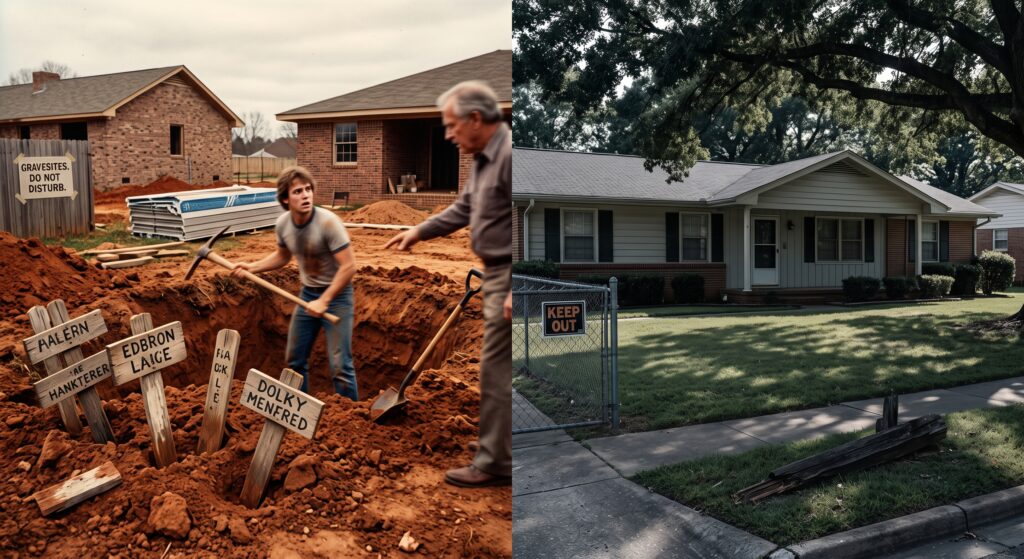
He knew because he had dug them himself. The land had been Black Hope, a cemetery for formerly enslaved people. As many as sixty were buried there in paupers’ graves, the last around 1939.
When the house turned strange
The Haneys found two graves and reinterred the remains with respect. Then, they say, the disturbances began.
They reported shadows, sparking clocks, doors that opened on their own, and objects that vanished and reappeared on the old grave sites. Neighbors described sinkholes shaped like coffins and cold spots in Texas heat.
Their neighbors Ben and Jean Williams told similar stories. Ben woke to his name spoken aloud. The families believed the dead were restless because the living had paved over them.
The horror the movies got wrong
People compare Black Hope to ‘Poltergeist,’ but the real story is grimmer and better documented. The Haneys sued the developer for failing to disclose the cemetery.
A jury first awarded them $142,000 for mental anguish. Then the verdict collapsed. The Texas Supreme Court case, Haney v. Purcell, turned on whether the developer actually knew a full graveyard lay beneath the lots.
The Haneys could prove only two isolated burials, not a mapped cemetery. The court reversed the award. They were ordered to pay roughly $50,000 in costs. The paranormal claims never mattered legally. The disclosure question did.
The real lesson under the lawn
Records suggest the Haney graves sat just outside the main cemetery, which may explain why other residents stayed quiet. The activity, whatever its cause, seemed to follow the disturbed ground.
Since the graves were relocated, the neighborhood has gone quiet. No lingering curse, just a story that refuses to fade.
Black Hope endures as a parable about ignoring history for real estate. Communities paved over the graves of the poor and forgotten, then acted surprised by the consequences. That part needs no ghost to be unsettling.
References & Further Reading
Justia, Haney v. Purcell Co. (Texas Supreme Court, 1989)