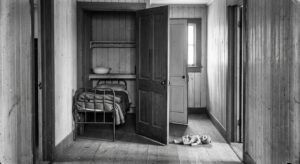
The most famous Shining film was never actually shot inside these walls.
A Grand Retreat in the Rockies
Freelan Oscar Stanley opened his namesake hotel in 1909, built as a mountain retreat for wealthy travelers seeking clean air and dramatic views. The Georgian Revival building still overlooks Lake Estes and the peaks of Rocky Mountain National Park.
Stanley chose the site partly for his health, hoping the altitude would ease his tuberculosis. The gamble paid off well enough that he spent decades building a resort community around the hotel itself.
The hotel quickly became a fixture for wealthy travelers seeking a fashionable escape from summer heat elsewhere in the country. Its guest list eventually included presidents, actors, and eventually a struggling young novelist who arrived nearly seven decades after opening day.
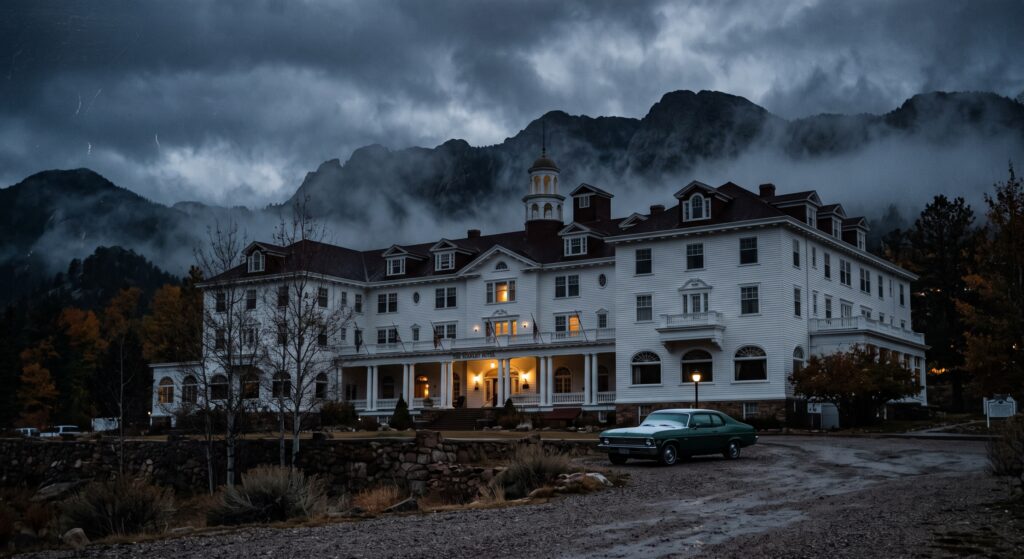
That resort reputation grew quietly for decades until one October night in 1974 changed everything. A young novelist checked in during the hotel’s final days before its winter closure.
One Night, Not a Season
Stephen King and his wife Tabitha arrived at the Stanley for a single overnight stay, not an extended visit, as some retellings imply. They discovered they were the hotel’s only guests that night, with staff already preparing to close for the season.
They ate dinner alone in an empty dining room while recorded orchestral music echoed down empty halls. That eerie stillness stayed with King long after checkout, and Room 217 became the seed for what eventually grew into his novel The Shining.
King had a nightmare that night about his young son fleeing through the hotel’s corridors. He woke, walked onto the balcony to smoke, and began shaping the idea that would become one of horror fiction’s most famous novels.
He later described the experience as feeling deliberately arranged, as if the empty dining room and echoing hallways existed specifically to plant a story in his mind. That sense of design, whether real or simply the product of an overactive imagination, became the emotional core of the book.
The visit lasted only until morning. Everything else—the maze of hallways, the isolation, the sense that something in the building was watching—came from that single night alone.
The Film That Was Never Shot Here
Many visitors assume Stanley Kubrick filmed his iconic 1980 adaptation inside these halls. He did not. Kubrick shot his interiors on a studio soundstage, drawing visual inspiration from Yosemite’s Ahwahnee Hotel rather than the Stanley itself.
Kubrick also changed the room number from 217 to 237. He reportedly did this at the request of a different hotel that feared guests would refuse to book its real Room 217 after the film’s release.
The Stanley finally got its film credit years later, when King produced his own 1997 television miniseries. Dissatisfied with Kubrick’s interpretation, King filmed that version on location at the actual hotel that inspired him.
That miniseries never achieved anywhere near the cultural footprint of Kubrick’s version. It remains the only adaptation actually shot inside the building most closely associated with the story. Most casual fans have never seen it.
That distinction rarely survives the retelling. Most ghost tours and articles imply the classic film was shot on-site, when the real filming connection belongs to a much less famous miniseries instead.
The Haunting That Predates the Novel
Room 217’s reputation began decades before King ever checked in. In June 1911, a gas leak caused an explosion while head housekeeper Elizabeth Wilson lit a lantern during a power outage.
The blast was severe enough to send a bathtub crashing through the floor below. Wilson survived her injuries and returned to work at the hotel, living for years afterward rather than dying in the incident, as some tellings mistakenly suggest.
Guests today report their belongings mysteriously tidied and their luggage unpacked, as if Wilson never quite stopped attending to the room. Staff describe the hauntings throughout the hotel as consistently gentle rather than menacing.
Unmarried couples staying in Room 217 sometimes report a cold, distinct presence wedging itself between them overnight. Staff attribute the detail to Wilson’s old-fashioned sensibilities about propriety.
The Stanley’s real story is stranger than the shorthand version most visitors hear. A survivor’s afterlife reputation and a film connection that belongs to the wrong movie both complicate the tidy legend.
That gap between legend and record does not make the hotel any less worth visiting. It just means the ghost tour script and the historical timeline are telling two slightly different stories.
A Hotel That Leaned Into Its Own Legend
Rather than distance itself from King’s story, the Stanley eventually embraced it fully. Management added a hedge maze to the grounds in 2015, borrowing directly from Kubrick’s film despite that film never being shot there.
The hotel now runs its ghost tours and hosts annual events tied to the novel and both film adaptations. Guests can watch either version on a dedicated hotel channel, looping continuously for anyone curious enough to compare them.
That commercial embrace makes sense given how much traffic the connection generates. Room 217 remains the hotel’s most requested booking nearly fifty years after King’s single overnight stay, often reserved months in advance.
Other rooms carry their reputations too. Guests in Room 401 have reported a closet door opening on its own. Room 428 carries reports similar to those associated with Room 217, despite no documented accident ever occurring there.
A hotel this old, sitting this far into the mountains, was probably always going to collect stories regardless of who checked in one particular October. King simply gave those stories their most famous shape.
A Hotel Built Around Its Founder
Freelan Stanley remains a presence at the hotel independent of any horror franchise. He and his wife Flora are both said to linger in the building they built together, decades after their deaths.
Flora’s spirit reportedly still plays piano in the concert hall late at night, a detail staff have reported for generations. Guests passing by after hours describe hearing melodies drifting from a room that should be empty and locked.
Freelan himself is said to appear near the billiard room, a space he reportedly enjoyed in life. Staff describe his presence as watchful rather than threatening, consistent with the same gentle tone that defines most hauntings throughout the property.
That consistency matters. A hotel full of contradictory, menacing spirits would feel like a marketing exercise. One that keeps returning to the same handful of gentle, specific figures feels more like an actual haunted place.
References & Further Reading
The Shining, The True Story Behind The Real-Life Stanley Hotel, ScreenRant
The Ghosts of the Stanley Hotel, Ghost City Tours
The Place That Inspired The Shining, Homes & Gardens travel feature
For more haunted locations across the country, see our complete guide to the The Most Haunted Places in America: A State-by-State Guide.