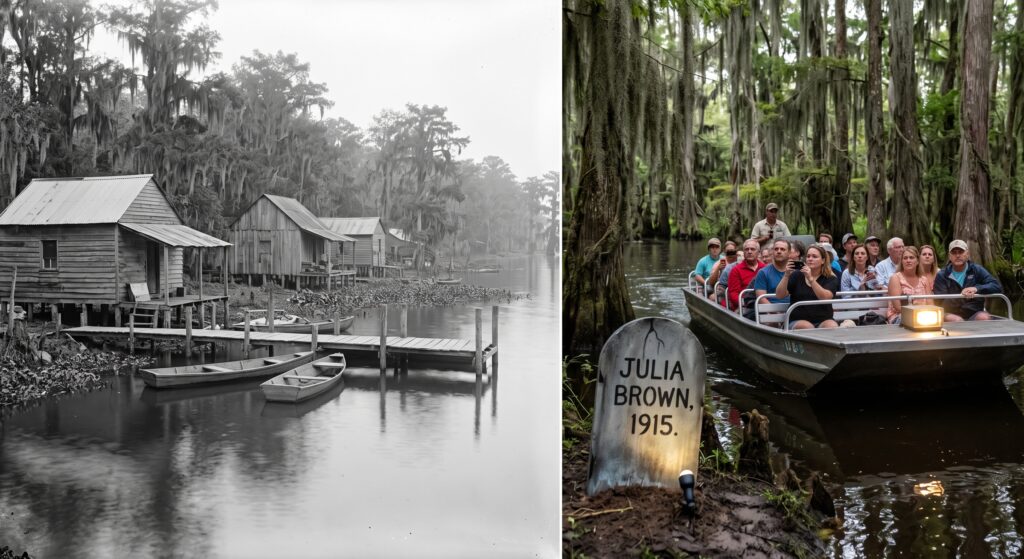
Some landscapes carry their history in their name. Hockomock is an Algonquin word. It means a place where spirits dwell, or a place of evil spirits. Colonists heard that name, saw the dark water, and never questioned why the woods felt wrong.
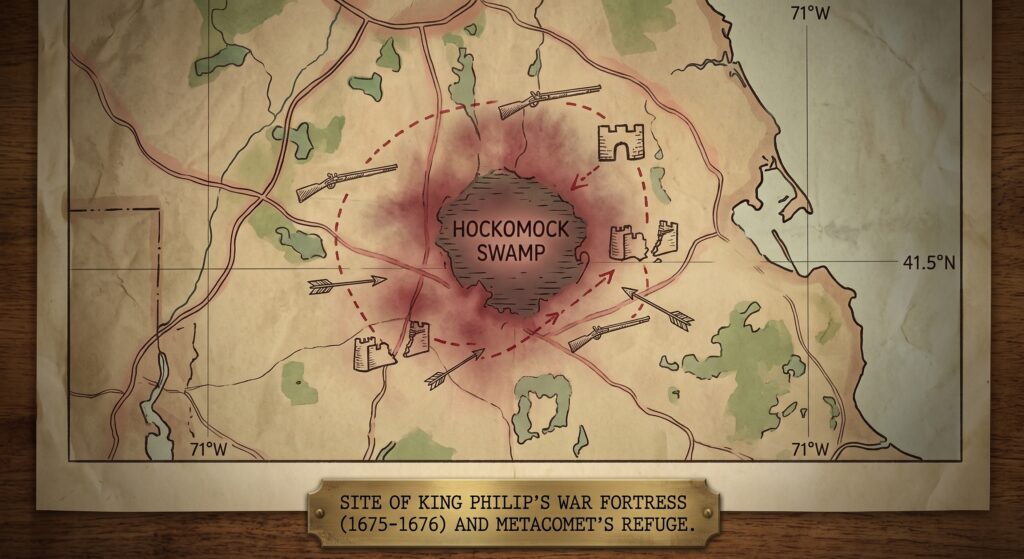
The swamp sits at the center of the Bridgewater Triangle, a 200-square-mile zone of strange reports. To understand the hauntings, you have to understand the war that soaked this ground.
A vortex mapped in the 1970s
Cryptozoologist Loren Coleman first defined the Triangle in the 1970s. The 17,000-acre Hockomock Swamp forms its core. Beneath the water lie native burial grounds thousands of years old.
The land holds deep human history. Excavators working ancient sites here reported red ochre that appeared to bubble as they unearthed it. The detail reads like horror. It also marks a place people held sacred long before English ships arrived.
The stain of King Philip’s War
This is the history the ghost stories dance around. During King Philip’s War from 1675 to 1676, the swamp served as a fortress for Chief Metacomet, known to the English as King Philip. The wetland hid and protected his people.
That war was catastrophic. Measured per capita, it ranks among the bloodiest conflicts in American history. It destroyed roughly 80 percent of the region’s Indigenous population. Colonists kept Metacomet’s severed head on a pike in Plymouth for 26 years.
The swamp is not spooky because of a cartoon monster. It is heavy because of what happened to the Wampanoag and their neighbors here.
Yellow days and giant snakes
The bizarre reports pile up across centuries. Early colonists described yellow skies, ghost fires that gave no heat, and enormous snakes. In 1939, Civilian Conservation Corps workers claimed they saw a black snake as thick as a stovepipe.
In 1970, a police officer investigated an 8-foot boa constrictor run over on a local road. Massive birds appear in the record too. Witnesses in 1971, 1988, and 2018 reported prehistoric-looking thunderbirds with wingspans of 8 to 12 feet.
Locals also describe a shaggy, ape-like beast that walks stiffly, like Frankenstein’s monster. The sightings vary wildly. The one constant is the swamp itself, vast and unmapped and impossible to search.
Reading the reports with care
Treat the sightings as a record of unease, not a zoology catalog. Giant snakes, heatless ghost fires, and enormous thunderbirds appear across three centuries of accounts. The specifics shift. The dread stays constant.
Some reports have mundane roots. An escaped exotic snake explains a few serpent stories. Large herons and vultures can look monstrous in poor light. Expectation does the rest, priming witnesses to see the extraordinary.
Still, the sheer persistence deserves respect. Generation after generation, people leave this swamp shaken. Whatever the cause, the fear is genuine and durable. That endurance is the real phenomenon worth studying.
Honoring the ground, not exploiting it
End with the history that should anchor everything else. King Philip’s War devastated the Indigenous peoples of this region. The Wampanoag and their neighbors lost most of their population and much of their world.
That trauma is not a spooky prop. It is a real wound in the American story, and this swamp held the people who fought and died in it. Any respectful account keeps that suffering in view rather than mining it for thrills.
So walk the edge of Hockomock with humility. Feel the weight of the Algonquin name for the place where spirits dwell. The heaviness is earned. It comes from history, and history deserves to be remembered plainly.
When land keeps score
Sit with the idea that geography can hold memory. Not literally, of course. But the stories a place generates often track the worst things that happened there. Hockomock generates dark stories because dark history soaked its ground.
The swamp witnessed a war of near-extermination. It hid a besieged people. It absorbed loss on a scale hard to imagine. Centuries later, the land still feels charged to those who walk it, and the legends supply a vocabulary for that unease.
That is why the ecological and the historical belong together here. The physical swamp is genuinely dangerous and disorienting. The historical swamp is genuinely tragic. Layer them and you get a place that resists both easy exploration and easy forgetting.
Approach Hockomock, then, as more than a monster hunt. It is a wetland, a graveyard, and a war memorial at once. The spirits the Algonquin named still stand guard over one of the heaviest chapters in New England’s past.