Roy Mackal followed a forked tongue and a serrated ridge to a conclusion herpetology still cannot confirm
A Silence Along the River
Some villages along the Motaba River will not discuss this animal at all. Ask about it directly, and the conversation stops. That silence, more than any single sighting, is what makes the nguma-monene one of the odder entries in Central African cryptozoology.
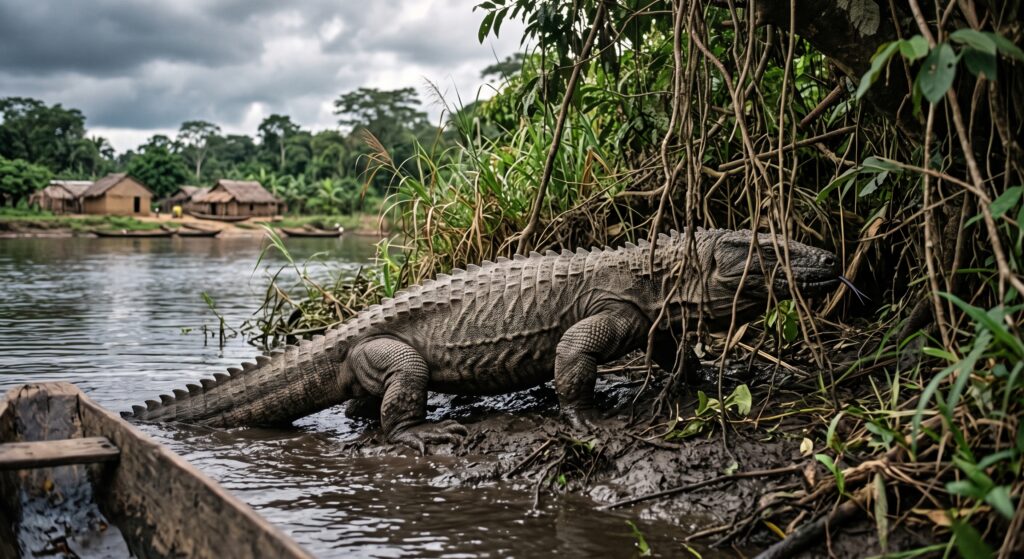
The name means “large python” in Lingala, though almost nobody who reports seeing the animal describes an actual snake. Witnesses instead describe a massive, low-slung, lizard-like body with short legs, a serrated ridge running along the spine, and a forked tongue flicking in and out. Reported lengths range from thirty to fifty feet, with a body several feet across. The color trends grayish-brown, close enough to river mud to vanish the moment it stops moving.
Two Sightings, Ten Years Apart
Two sightings anchor most of the modern record. In 1961, the sister of a Congolese government official was bathing in the Motaba River. A long neck and head rose from the water roughly fifty feet away. Villagers ran to the riverbank and watched the animal move upstream, its tongue flicking visibly. Ten years later, in November 1971, a missionary named Joseph Ellis was traveling the same river by motorized canoe. He watched an elongated, ridge-backed animal swim across the water about one hundred feet away, then climb onto the far bank and vanish into thick vegetation.
Mackal’s Chain of Logic
Biologist Roy Mackal, who gathered both accounts during his Congo expeditions, built his analysis around a simple chain of logic rather than a preferred conclusion. He started with the forked tongue. Among reptiles, only snakes and lizards use that particular sensory tool. That single detail ruled out crocodilians immediately, despite the animal’s size and its riverside habitat. Mackal then eliminated snakes. None of the roughly twenty-five hundred known snake species carry anything resembling a ridged or serrated back. By process of elimination, he concluded the animal had to be some form of lizard, however large that conclusion required it to be.
This reasoning deserves more attention than it usually receives, because it avoids the trap that swallows so many cryptid investigations. Mackal did not start with a dinosaur and search for matching testimony. He started with two specific physical details, the tongue and the ridge, and followed them wherever they logically led. The chain is not proof of anything living in that river. It is a rare example of a cryptozoologist reasoning from evidence outward instead of backward from a favorite theory.
The trouble is that the conclusion still lands somewhere without a clean match. Africa’s largest known lizards are monitor lizards, and monitors can grow long enough to account for some sighting estimates. No documented monitor species, however, carries a serrated dorsal ridge. That gap leaves Mackal’s own logic pointing toward an animal that current herpetology simply does not catalogue.
A Lizard With No Name, or Simply a Snake
One further hypothesis leans more into paleontology. Mackal floated a connection to dolichosaurs, an extinct group of long-bodied marine reptiles from the Late Cretaceous with reduced limbs and elongated, snakelike frames. Fossils of true dolichosaurs have turned up in England, Lebanon, and parts of the former Yugoslavia, so the body plan is not invented for this case. No dolichosaur fossil has ever been found in Africa. The group is also generally considered extinct for roughly ninety-five million years, which makes this explanation more speculative than the plain monitor lizard theory.
A far more mundane explanation deserves equal weight. The African rock python is an exceptionally strong swimmer and can reach impressive lengths. A frightened observer could easily mistake a python crossing open water at dusk for something larger and stranger. Given that the animal’s own name already means large python in the local language, this may be the least exotic explanation on the table. It may also be the most likely, even if it is the least exciting one.
Cousins Across the Border and a Culture of Silence
Regional folklore links the nguma-monene to several neighboring cryptids, including the badigui and a creature called the yoli in parts of Cameroon. Some researchers, including Mackal himself, suspected that these names might describe the same animal, seen through different dialects and different encounters. Bernard Heuvelmans went further, drawing a connection to older legends of a crested, crowing serpent recorded elsewhere in Central African oral tradition. We cannot determine whether these names point to one species or several without physical remains. The overlap still suggests a shared cultural memory of something large, ridged, and dangerous. That memory predates any outside expedition that arrived to ask about it.
The taboo surrounding the subject adds another layer worth taking seriously rather than dismissing as simple superstition. After the 1961 sighting, villagers who had gathered to watch the animal reportedly grew reluctant to discuss it once they returned home. That reaction shows up repeatedly in Congo Basin cryptid cases, and it complicates any attempt to gather a large, comparable sample of testimony. A culture that treats a topic as dangerous to discuss will naturally produce fewer accounts. This happens not because fewer sightings occurred, but because fewer people are willing to repeat them to a stranger with a notebook.
What the Investigation Itself Reveals
What makes the nguma-monene worth revisiting is not the promise of a hidden dinosaur. It is the shape of the investigation itself that matters. A careful researcher followed two specific clues to their logical end and arrived at an animal nobody can currently name. Villages that treat the subject as taboo are not necessarily hiding a monster. They may simply be protecting a story that outsiders have a habit of turning into something it never claimed to be.
The Motaba River keeps its secrets well. A python that swims farther than expected and a lizard that may not exist yet in any field guide both remain candidates. The true answer likely sits closer to the riverbank than to any prehistoric family tree.
For now, the honest position is uncertainty rather than either extreme. The nguma-monene has not earned a confirmed identity, but it has earned a more careful reading than the usual instinct to reach straight for a dinosaur. Two witnesses, four decades apart, described strikingly similar features on the same stretch of river. That kind of quiet consistency, without any hoax, photograph, or profit motive attached to it, is rarer in cryptozoology than the headlines usually suggest.
References & Further Reading
Detailed sighting records for the 1961 and 1971 Motaba River encounters
Overview of the taboo surrounding the subject and modern folkloric context
Summary of the dolichosaur hypothesis and related Central African cryptid names



[…] by the Kongamato, a winged terror that resembles a pterosaur. In the rivers, the heavily scaled Dingonek (the serpent-lizard) has baffled investigators for a century. Further south, South African folklore warns of the […]