How thirteen days in 1836 still shape downtown San Antonio long after dark
Thirteen Days That Defined a Republic
The Battle of the Alamo unfolded over thirteen days in early 1836. It ended on March 6, when Mexican forces under General Santa Anna overwhelmed the small garrison of Texan defenders inside the old mission compound. Nearly all of the roughly 200 defenders died in the final assault, including well known figures like Jim Bowie and William Travis.
Santa Anna ordered the bodies burned rather than buried, denying the defenders a traditional burial and adding a layer of desecration to an already brutal defeat. The battle became a rallying cry for Texan independence, and “Remember the Alamo” fueled the movement that secured Texas’s separation from Mexico weeks later.
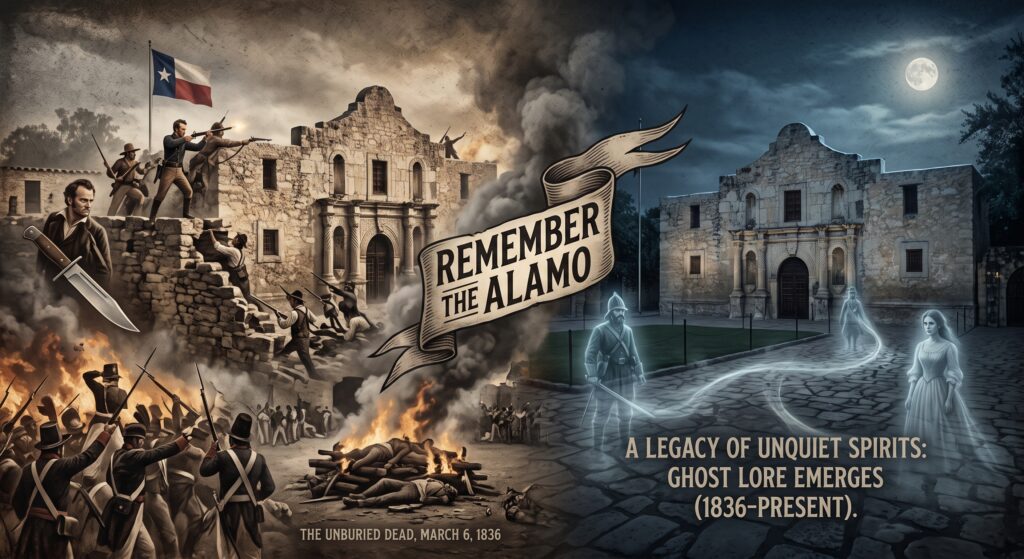
That combination of violent death and denied burial rites is a pattern that shows up repeatedly in ghost lore across many cultures. Bodies burned rather than laid to rest are often believed to struggle finding peace. The Alamo’s oldest ghost stories emerged almost immediately after the battle, long before modern tourism ever touched the site, and they have grown steadily ever since.
The mission itself predates the battle by more than a century, founded in 1718 as a Spanish outpost before ever becoming a military target. That long earlier history as a place of worship and community gathering adds another layer beneath the 1836 siege. Some researchers believe it contributes to the site’s unusually consistent ghost reports across nearly two centuries.
The Folklore and the Legends
The Chapel and the Wall of Fire
Some of the earliest Alamo ghost stories date to the years immediately following the battle. According to period accounts, Mexican soldiers ordered to destroy the chapel years later refused, reportedly after encountering flaming spirits or a wall of fire blocking their approach.
Whether these accounts reflect genuine supernatural defense of the site or a convenient excuse to avoid demolishing a building already gaining sacred status, the chapel survived. Today it stands as the Alamo’s most recognizable structure, the building most visitors picture when they hear the site’s name.
Jim Bowie and the Menger Hotel
Jim Bowie died in his sickbed during the final assault, too ill to stand and fight alongside the other defenders. His room stood within the Alamo’s low barracks until officials demolished that section of the compound in 1871.
Local legend holds that when workers tore down the barracks, Bowie’s spirit and others migrated across the street to the Menger Hotel, built in 1859. Guests at the Menger have reported Bowie’s ghost ever since, often described near the hotel’s original wing. Whether spirits can genuinely relocate when their original setting disappears is unanswerable, but the story reflects something true about historic preservation. When a building falls, the stories attached to it rarely disappear with it. They simply find a new address nearby.
Sallie White and the Lady in Blue
The Menger Hotel carries its own independent haunted reputation, separate from any borrowed Alamo spirits. Sallie White, a chambermaid, was shot and killed in 1876 by her husband inside the hotel. Guests report her wandering the original wing wearing a bandana, sometimes accompanied by the faint sound of housekeeping work being done by no visible staff.
A second figure, known only as the Lady in Blue, appears silently knitting in the hotel’s rotunda. No records identify who she was in life. Unlike Sallie White, her story carries no documented origin at all, only decades of consistent visitor reports describing the same quiet, seated figure.
The Regret of Louis Moses Rose
According to legend, William Travis drew a line in the sand before the final assault, asking defenders willing to stay and die to cross it. Louis Moses Rose refused, choosing to escape rather than face certain death.
Rose survived the battle but reportedly spent the rest of his life haunted by regret over his decision. Visitors report a lone figure walking toward San Antonio at night, sometimes heard saying he is going “to the Alamo, where I belong.” Most Alamo ghosts are tied to defenders who died fighting. Rose’s reported spirit is rarer: guilt from surviving rather than grief from dying. His story asks a different question than most ghost tales, about what happens to the people history remembers for walking away.
Modern Spatial Bleed
The Alamo’s unsettled energy, according to local legend, has spread into surrounding downtown San Antonio. River Center Mall sits over the site of a former coffin shop, near where soldiers’ bodies were burned. Employees have generated decades of reports describing moved objects and unexplained sounds after closing.
Market Square’s Children’s Park, resting place for some Mexican soldiers killed in the battle, produces a different reaction. Visitors describe a sudden, unexplained sense of dread while walking through, with no specific figure or sound attached to the feeling at all.
Visitor Information and Decorum
The Alamo operates as a sacred shrine, and its rules reflect that status. Hats are prohibited inside the church, and staff ban photography and cell phone use in the same space. Staff ask all visitors to maintain a quiet, reverent tone throughout the grounds.
Grounds close at 5:30 p.m. most of the year, extending to 7:00 p.m. during peak season. The Menger Hotel, River Center Mall, and Market Square all operate as separate private or municipal properties with their own hours and rules, distinct from the Alamo itself. Confirm hours directly with each site before planning an evening visit.
Because the Alamo sits in the middle of a busy modern downtown, respectful behavior matters even more than it does at a rural battlefield. Treat the site with the same quiet reverence you would bring to any shrine, regardless of how many gift shops and hotels now surround it.
References & Further Reading
The Alamo San Antonio (Official Site)
Visit San Antonio: The Alamo Plan Your Visit
World History Encyclopedia: Ghosts of the Alamo
Alamo Ghost Archive – Sons of DeWitt Colony Texas
Emily Morgan Hotel – Tales from Emily Morgan Hotel
For more haunted locations across the country, see our complete guide to the The Most Haunted Places in America: A State-by-State Guide.