A woman sat on her porch, played guitar, and sang that she would die and take the whole town with her. Two days later, a hurricane erased her town from the map. That timing built a legend. It also buried a real person. The story of Julia Brown is famous. The truth is stranger, and it reveals how myths get manufactured.
A settlement at the edge of the water
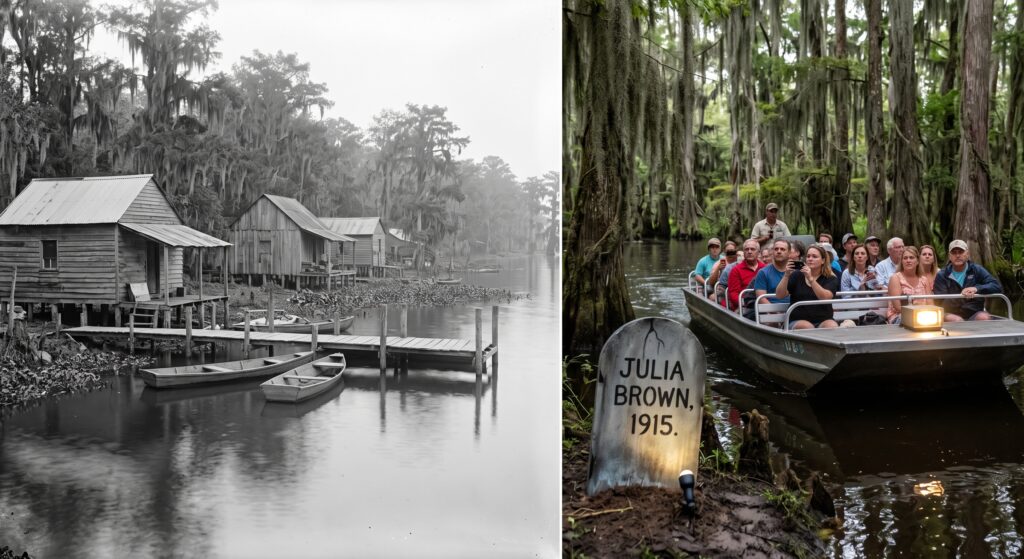
Frenier sat on the shore of Lake Pontchartrain in St. John the Baptist Parish. German immigrants founded it. Residents farmed cabbage, cut cypress, and shipped sauerkraut to New Orleans by rail. The place had no doctors, no roads, and no electricity.
Julia Brown lived here. Census records show she was born Julia Bernard around 1845. She married Celestin Brown, a laborer, and later inherited a 40-acre homestead. She raised children who could read. Neighbors called her Aunt Julie.
In a town without physicians, she filled a vital role. She served as a folk healer, a traiteur, and a midwife. She used herbs, roots, and whatever knowledge the swamp allowed. People sought her when sickness struck and no one else could help.
The song and the storm
Here is the detail everyone remembers. Julia sang a song she wrote. One refrain warned that one day she would die and everything would die with her. Survivors documented the lyric. It was real.
On September 29, 1915, the New Orleans Hurricane struck. Winds hit 125 miles per hour. A 13-foot storm surge swallowed streets and shanties. Townsfolk crowded into the Frenier railroad depot for shelter. The building collapsed and killed 25 people inside.
The storm destroyed Frenier, Ruddock, and Napton completely. Close to 300 people died across Louisiana. Nearly 60 died in Frenier and Ruddock alone. Rescuers found Julia’s body afterward. The surge swept her casket away, and no one ever recovered it.
Who invented the voodoo priestess?
Now the twist. The voodoo-priestess version did not exist for most of a century. Researchers trace its public surface to around 2010. Before that, locals remembered a beloved healer, not a vengeful sorceress.
The transformation had an accidental author. Retired parish lieutenant Wayne Norwood wrote a book about the 1915 storm. Television producers asked if they could call Julia a voodoo person for the show. He shrugged and agreed. He later apologized publicly, saying the whole distortion was his fault.
Swamp tours ran with it. Guides now point to a graveyard prop marked 1915. They tell riders that Julia cursed the town and still haunts the water. The story sells boat tickets. It also does something uglier.
The cost of a good ghost story
Consider what the myth erased. A literate Black landowner, a wife, and a devoted community healer became a cackling monster. Her real work saving lives vanished. A cartoon villain took her place.
Historians have named this pattern directly. They describe a shift from housewife to spectacle, a familiar move applied to Black figures throughout American history. The legend did not honor Julia. It replaced her.
So walk the Manchac swamp if you like. Watch the pea-green water and the moss hanging off ancient cypress. Feel the heavy air. Then remember the woman under the myth. Aunt Julie healed her neighbors. The storm was nature, not vengeance.
The town that vanished
Frenier deserves its own eulogy. Before the storm, houses spread across five or six blocks. Roughly 800 people lived in the wider community. Cabbage grew so well here that the settlement exported sauerkraut all the way to New Orleans.
The isolation that made Julia essential also made everyone vulnerable. No roads connected the town to the city. No telephone lines carried warnings. When the storm formed in the Gulf, residents had almost no way to learn how fierce it would grow.
That helplessness matters to the legend. People did not gather at a funeral in defiance of a curse. They were simply trapped, cut off, and unprepared. The hurricane did not target Frenier. It found an easy victim.
Why the wrong story spreads faster
Ask why the curse version won. A vengeful priestess makes a thrilling tour. A widowed healer who saved lives does not sell boat tickets as easily. The market rewards the scarier lie.
There is a deeper mechanism too. A prophecy that comes true feels like proof of hidden power. In truth, Julia’s song was a common lament about mortality, not a spell. The storm’s timing was cruel coincidence, dressed up as fate.
Coincidence is a poor villain, so storytellers replaced it. They gave the disaster an author and the town a monster. The neat narrative buried the messy truth, which is that nature killed nearly 300 people for no reason at all.
Remembering Aunt Julie
You can still visit the area. Swamp tour companies run boats past a cemetery site and a cabin they link to Julia. Treat the theatrics with a raised eyebrow. The 1915 grave marker is a prop, and the real graves washed away.
What remains is worth honoring anyway. Somewhere in that swamp lie the bones of a community that farmed, sang, and healed one another. Julia Brown stood at the center of that community as its caretaker.
Give her the dignity the legend stole. She was not a harbinger of doom. She was Aunt Julie, the woman the town called when nothing else could help. That is a better story, and it has the advantage of being true.
A curse the tourism industry needs
Follow the money one more step. Swamp tours built a business on Julia’s ghost. A vengeful priestess draws paying passengers into the bayou at dusk. The legend is now an economic asset, and assets resist correction.
That incentive keeps the false version alive. Guides repeat the curse because riders expect it. Blogs recycle the curse because it earns clicks. Television dramatized it because it fills an hour. The truth, quieter and sadder, loses at every turn.
None of this means you should skip the swamp. Go, watch the cypress and the still green water, and enjoy the atmosphere. Just carry the real history with you. Let the woman outlive the myth, at least in your own mind.
References & Further Reading
Mental Floss – The Legend and Truth of the Voodoo Priestess
Deep South Magazine – Debunking Her Voodoo Priestess Mythos
L’Observateur – Retired Lieutenant Clears Air About Julia Brown