The practice has a name most people never hear. Catoptromancy, from the Greek “katoptron” for mirror and “manteia” for divination. It means reading the future in a reflective surface, and it is among the oldest forms of scrying on record.
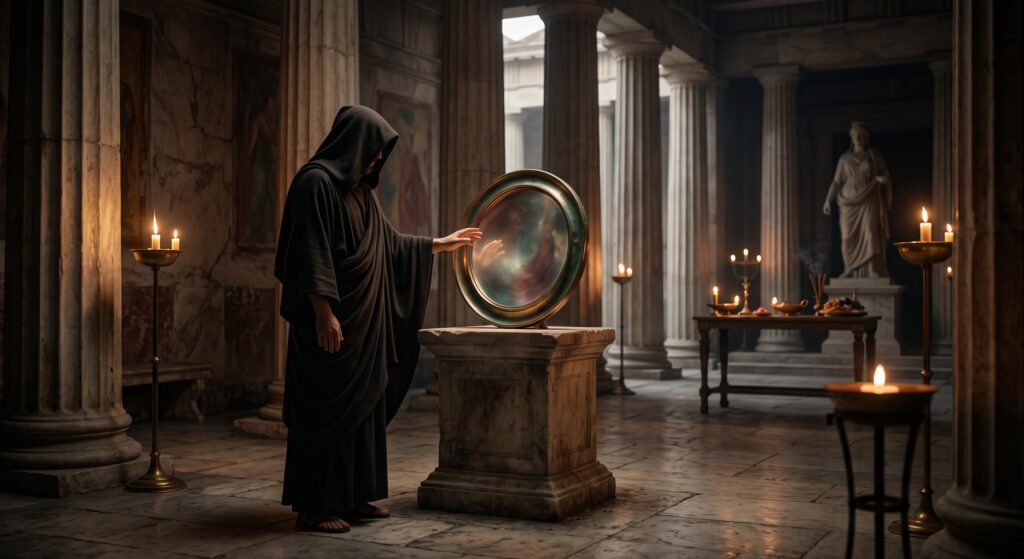
This is not the stuff of sleepover dares. It is a documented ancient rite, practiced in temples, satirized in Greek comedy, and blamed for predicting the death of an emperor. The written trail runs back more than 2,000 years, and it is far richer than most retellings admit.
Modern mirror lore tends to start with campfire stories. The real history starts in marble sanctuaries and imperial courts. Understanding catoptromancy means setting aside the sleepover chant and following the practice to where it actually lived, among priests, philosophers, and the dying who came seeking answers.
The Oracle at Patras
The clearest account comes from Pausanias, a Greek geographer writing in the second century AD. He described an oracle outside the Temple of Demeter in the city of Patras, and its purpose was unusually narrow.
This oracle served the sick alone. A person would pray to the goddess, burn incense, then lower a mirror on a thread until its base just kissed the surface of a sacred spring. Looking into the glass, they read their fate. A fresh, healthy face meant recovery. A ghastly, drawn face foretold death.
Notice the structure. This was no loose bit of folk magic. It was a fixed temple ritual with prayer, offering, and a precise method, tied to a specific goddess of agriculture and healing. The reflection delivered a verdict, and people traveled to receive it.
Rome and the Reader of Mirrors
The Romans adopted the practice and gave its specialists a title. Priests skilled in mirror reading were called specularii, and they gazed into polished metal to seek guidance from the gods.
Roman attitudes were mixed. Mirror divination held an uneasy place, tolerated inside official institutions yet eyed with suspicion as a private art. Pliny the Elder noted the belief that polished surfaces could summon images of gods or spirits, writing with the same blend of curiosity and worry Romans brought to much divination.
The stakes could be political. According to one late Roman source, catoptromancers accurately foretold the death of Julian the Apostate. Reading a mirror was not always a private comfort. Sometimes it brushed against the fate of emperors.
Older Than Greece Itself
The Greeks did not invent the impulse. They inherited it. Long before glass mirrors existed, people scried in whatever held a reflection: still pools, polished bronze, copper discs, and bowls of dark liquid or ink.
The same instinct surfaced in cultures with no contact between them. Egyptians, Persians, and others developed mirror divination on their own. That independent repetition suggests something about human perception itself. A reflective surface seems to invite the same intuition everywhere, the sense that a face in the glass might reveal more than a face.
Even the satirists knew it. The playwright Aristophanes mocked the practice on the Athenian stage, which tells us it was common enough to lampoon. A joke only lands when the audience recognizes the target.
The Thread That Reaches Us
What stayed constant across two millennia was not the belief but the setup. A mirror, low light, and a fixed gaze. Only the goal shifted from age to age.
First people sought the future, then the identity of thieves, then angels in the case of Renaissance magicians. In our own time, grief counselors have revived mirror gazing in the psychomanteum, where sitters hope to glimpse the faces of the people they miss.
That long arc is the real story of the mirror. The tool never changed. Our questions did. From a sick pilgrim at Patras to a modern mourner in a dim room, the same dark glass keeps returning our own reflection, and the same hope keeps us staring into it.
How the Ritual Actually Worked
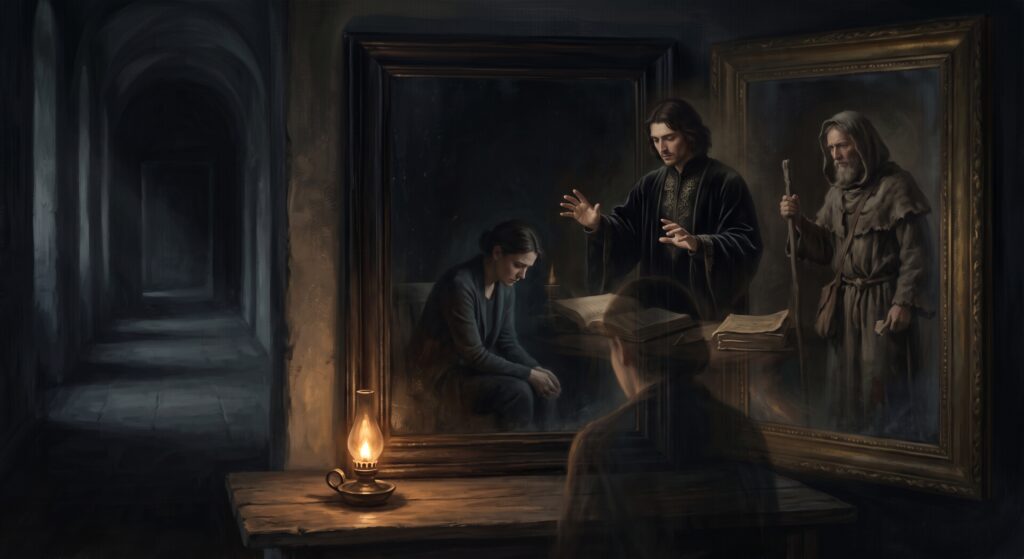
Ancient scryers understood conditions that modern psychology only later named. They favored dim light, a fixed surface, and a long, unbroken gaze. The Patras oracle added prayer and incense, but the sensory core stayed simple.
The earliest mirrors were not glass at all. Practitioners scried in still water, polished bronze, dark bowls of ink, and discs of obsidian. What mattered was a surface that reflected without revealing much detail, a screen the mind could fill with meaning.
The setting mattered as much as the tool. A quiet sanctuary, a controlled ritual, a mind already primed by faith and fear. Under those conditions, a reflection could seem to move, deepen, or answer. The environment shaped what the gazer believed they saw.
Historians admit the exact methods varied widely, with no single fixed procedure across sites. That inconsistency is telling. What endured was not a rulebook but an intuition, the sense that a reflective surface could open onto something hidden.
The Face That Changes in the Glass
There is a real perceptual reason mirror gazing produces visions. Stare at your own dim reflection long enough and it begins to distort. Features blur, shift, and rearrange into something strange. Researchers have studied this effect under controlled conditions.
The cause lies in how the brain handles a steady image in low light. Deprived of change, perception starts to break down and rebuild the face on its own. A pilgrim at Patras, told the glass would foretell life or death, would read those shifting features as prophecy.
Context supplied the meaning. A healthy face glimpsed in the water promised survival, while a drawn and hollow one warned of death. The same distortion that a modern researcher records in a lab was, in the sanctuary, a message from a goddess. Belief decided how the flickering image was read.
This does not debunk the experience so much as explain its power. The visions were not simple lies. People truly saw their faces transform, and in a sacred, expectant setting, that transformation carried enormous weight.
The ancients built an entire divinatory art around an effect they could feel but not name. That is a kind of genius, even if the prophecy was really the mind meeting itself in the dark. For the modern folk version of this impulse, see our post on mirror gazing and the Bloody Mary ritual.