In 1930, guards refused to unlock the cells. Ninety years later, the screams reportedly still echo across the parking lot.
Fans park their cars, buy their tickets, and file into Nationwide Arena for hockey and concerts in downtown Columbus. Almost none of them know they are standing on the site of the worst prison fire in American history, where 322 men died locked inside their cells.
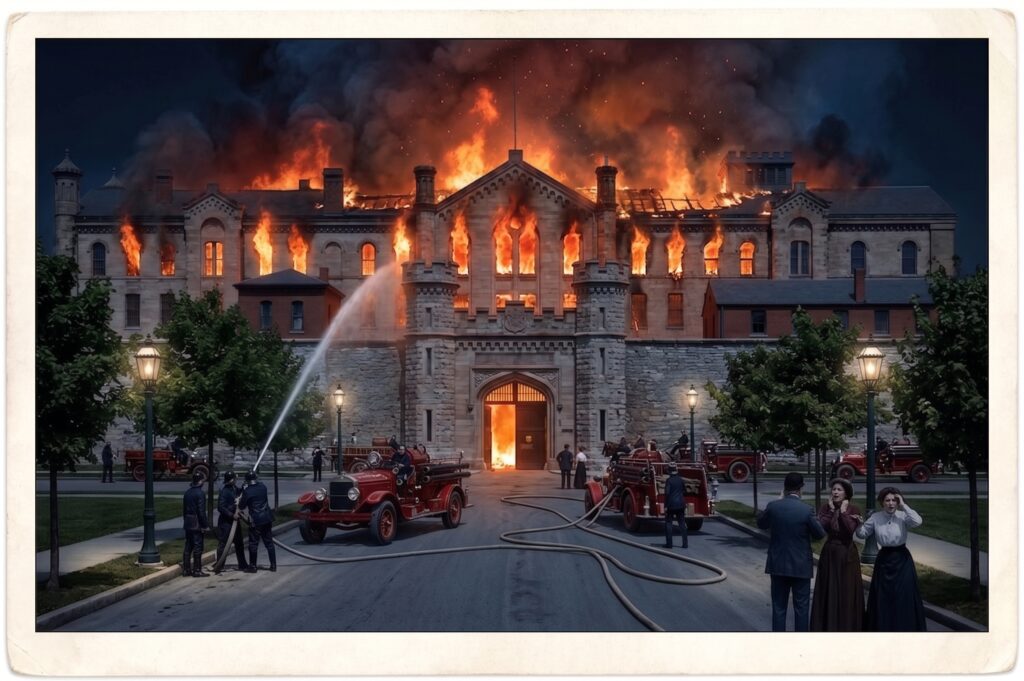
The reports that drift out of the arena’s parking structures, disembodied screams, phantom smoke, the sense of something burning, make grim sense once you know what happened here on the evening of April 21, 1930. The ground under the Arena District holds one of the country’s darkest single days.
This is not a story about a playful ghost or a friendly presence. It is about a mass death that could have been prevented, and about how easily a city can pave over its worst memory and forget.
The Ohio Penitentiary
The Ohio Penitentiary operated in downtown Columbus from 1834 until 1984, a grim stone complex with a brutal reputation. It endured cholera epidemics and riots across its long life. At its peak it held more than 5,000 prisoners, and on the day of the fire it was packed to roughly twice its intended capacity.
Overcrowding had been a documented problem for two decades before the disaster. Officials knew the prison held far more men than it was built for. The warnings existed. The reforms did not. The conditions that made a catastrophe possible were left in place year after year.
The prison had no sprinkler system, no real fire plan, and cell keys kept far away from the cells themselves in a guardhouse. Every element of a catastrophe was already in place before anyone struck a match. All the disaster needed was a spark and a locked door, and on that April evening it got both.
The prison had also become a symbol of everything wrong with the era’s approach to punishment. It warehoused men by the thousands with little thought to safety or reform. The overcrowding was not a secret failure but a known one, tolerated for decades. When the fire came, it did not expose a hidden flaw. It ignited a disaster that officials had effectively been building toward for twenty years.
The night the guards would not open the doors
The fire began as a candle set to oily rags on the roof of the six-story West Block, where construction was underway. Investigators later concluded that inmates had set it as a diversion for an escape attempt, though the exact cause is still disputed to this day. The blaze smoldered, then erupted in the evening, just after prisoners had been locked in for the night.
As smoke filled the cellblocks, trapped men begged to be released. The guards refused, fearing a mass escape, and a supervisor reportedly ordered a key door kept shut. The men who could have opened the cells chose not to, and hundreds of prisoners were left to face the smoke behind locked steel.
Amid the horror came acts of desperate courage. Some inmates overpowered a guard, seized his keys, and ran back into the flames to free others. One prisoner reportedly returned again and again to drag fellow inmates out before the smoke took him. By the time it ended, 322 men had died, most suffocating in their cells with no way out.
What lingers in the parking structure
The prison closed in 1984 and was demolished, and Nationwide Arena rose in what is now called the Arena District. The reports began soon after the new venue opened. Visitors, security, and staff have described disembodied screams and crying echoing from the parking structures.
Others describe phantom smoke and flames in areas where the old cell blocks once stood, brief impressions of a fire that ended almost a century ago. The details cluster around the exact footprint of the disaster, as though the ground remembers what the buildings forgot.
Read as spatial memory, the accounts are almost unbearably specific. The men died trapped and pleading in a fire that others could have stopped. If any event leaves an imprint on a place, a mass death by locked door and smoke would be it. The alleged sounds are not random noises. They echo the precise horror of that night, the begging and the screaming behind doors that stayed shut.
A tragedy with no marker
The fire reshaped American prison fire codes and helped spur the creation of the Ohio Parole Board in 1931, which worked to reduce the overcrowding that made the disaster so deadly. The reforms it triggered saved lives elsewhere. Yet nearly a century later, there is still no official historical marker at the site.
By one account, no one has ever even applied for one. The deadliest prison fire in the nation’s history is commemorated mainly by a wall display in the Arena District and, unofficially, by a ghost story. The men who died locked in their cells have no formal monument above their place of death.
That absence is the real haunting. A sleek modern entertainment hub now sits over a chapter of American carceral history that the public has largely forgotten. People cheer for hockey and sway at concerts on ground where hundreds burned, unaware of any of it.
The screams in the parking lot, whether one believes in them or not, do a job the historical markers never got around to doing. They insist that 322 men died here, that their deaths were preventable, and that someone should remember. In the absence of a monument, the legend itself has become the memorial.
The forgetting was not entirely accidental. Prisoners are among the easiest dead to overlook, and a society rarely rushes to memorialize men who died behind bars. That silence is part of what makes the site feel so heavy. These were human beings, many awaiting release, who suffocated because someone feared they might escape. A city that would mourn any other mass death has mostly looked away from this one. The ghost story, grim as it is, refuses that convenience. It drags the number 322 back into the light every time it is told.
References & Further Reading
10TV, Ohio Penitentiary fire was worst in US history, but no historic marker exists