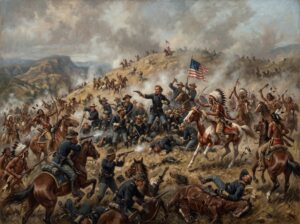
George Gipp gave college football its most famous deathbed line. Notre Dame’s first All-American died at 25, and years later coach Knute Rockne rallied an underdog team with words attributed to him: Win one for the Gipper. Ronald Reagan later played him on screen, and the phrase became political shorthand. Gipp did not just become a local legend. He became a national one.
Legends of that size rarely rest quietly. Their fame keeps them present long after the person is gone, retold, reused, and occasionally disturbed. And in 2007, someone quite literally opened his grave.
The story of Gipp’s ghost is really two stories: the myth built while he rested undisturbed and the strange modern chapter that unfolded when his rest was interrupted.
A death on the steps
The popular account, part fact and part folklore, holds that Gipp caught a chill after being locked out and sleeping on the steps of Washington Hall one cold December night. Storytellers love that detail, the hero felled not by an opponent but by a closed door and a hard winter.
What is certain is less cinematic but no less sad. He contracted a strep throat infection and pneumonia and died in December 1920, just weeks after being named an All-American. He was 25 years old, at the peak of his fame, gone almost overnight.
His career numbers were staggering for the era, and several of his Notre Dame records stood for more than fifty years. The combination of brilliance and early death is the raw material of myth. Washington Hall, near where he supposedly fell ill, became the natural center of his afterlife on campus.
Rockne’s famous speech, delivered eight years after Gipp died, sealed the legend permanently. Whether Gipp actually spoke those deathbed words is impossible to verify, and many historians doubt it. The doubt never mattered. The speech worked, the team won, and the phrase entered the language. Gipp became less a man than a rallying cry, which is a strange sort of immortality and a lonely one.
The hauntings of Washington Hall
Students and staff have reported the building’s disturbances for generations. Doors slam without a hand on them. Papers rustle in still air. Cold spots appear from nowhere, and a phantom French horn sounds a melancholy note through empty rooms late at night.
None of it is unique to Notre Dame. Old performance halls collect exactly these stories: the slam, the chill, and the music with no musician. What makes Washington Hall’s version endure is the name attached to it. A generic ghost is forgettable. The Gipper is not.
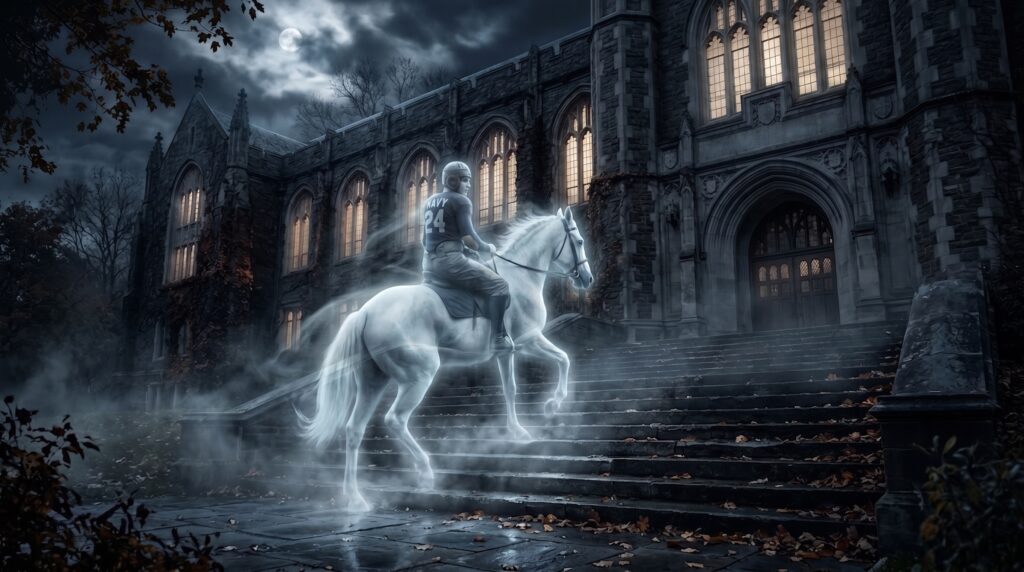
The most cinematic legend dates to campus lore from 1925. In it, Gipp’s spirit was seen riding a spectral white horse up the steps of Washington Hall, returning to join his teammates. Whether anyone truly witnessed it hardly matters now. The image, a dead hero on a ghost horse climbing the steps where he fell, is too good for the campus to ever surrender.
The phantom horn deserves its own note. Old theaters often report stray music, but a French horn is oddly specific. Generations of drama students have sworn they heard it echo through Washington Hall after dark. Whether wind, pipes, or something stranger, the sound keeps the building firmly inside the legend.
The exhumation that angered a legend
In 2007, Gipp’s body was exhumed from a cemetery in Michigan‘s Upper Peninsula for DNA testing. A relative sought to settle whether Gipp had fathered a child out of wedlock with a woman he had dated before his death. His right femur was removed and tested, and the results showed no biological link. The rest of his remains were reburied the same day.
The exhumation, filmed by an ESPN crew, ignited a bitter family feud. Some relatives said they were never told it would happen and never would have agreed to it. A lawsuit followed, alleging the disturbance had caused shock and mortification, before it was ultimately dismissed by the court.
Campus storytellers noted the timing of it all and drew the obvious conclusion. A hero worshipped for the better part of a century had his bones disturbed for a paternity question, and the family fractured over it. To the folklore-minded, that was not coincidence. The Gipper’s spirit, they decided, did not appreciate having his grave opened, and the discord that followed was proof.
Myth, memory, and a restless hero
Gipp occupies a rare double role in American life. He is a fixture of football mythology, immortalized in a locker-room speech and a Hollywood film that helped launch a future president’s public image. He is also a permanent resident of Notre Dame campus folklore, complete with a ghost horse and a haunted hall.
Few figures live that fully in both the national imagination and a single building’s ghost story. Most legends belong to one or the other. Gipp belongs to both, and the two feed each other. The famous speech keeps his name alive nationally, and the campus ghost keeps it alive locally.
The 2007 exhumation gave the old legend a modern chapter. A hero remembered for a stirring call to victory had his rest broken for a DNA test. The campus responded the only way it knew how. It decided the ghost was watching and displeased.
Win one for the Gipper, the speech goes. At Notre Dame, they suspect the Gipper is still keeping score, still climbing those steps on his spectral horse, still very much aware of what the living do with his memory. A legend that large does not simply lie still, and Notre Dame would not want it to.
The layers of the Gipp legend also make it hard to separate fact from embellishment, and that blurring is part of its staying power. Did he really sleep on the steps of Washington Hall? Did anyone truly see a ghost horse in 1925? The record is thin, and the retellings have polished every rough edge. What survives is not history but something sturdier: a story the campus wants to believe. Each generation of students inherits it, adds a detail, and passes it along, keeping the Gipper riding through Notre Dame lore long after the facts blurred.
References & Further Reading
Goshen News, Gipp’s would-be relatives: We did not know about the exhumation