The world’s oldest theatre district holds its ghosts as tightly as its history. Step off the pavement into a West End theatre and you enter one of the most crowded afterlives on earth. London’s theatreland packs more reported spirits into a few square miles than almost anywhere else, and the reason is brutally simple. These buildings are old, and they refuse to stay the same. Fires gut them. Renovations tear open their walls. Assassins fire pistols from the stalls. Each disruption seems to shake something loose, and the people who gave their lives to these stages appear reluctant to surrender their seats.
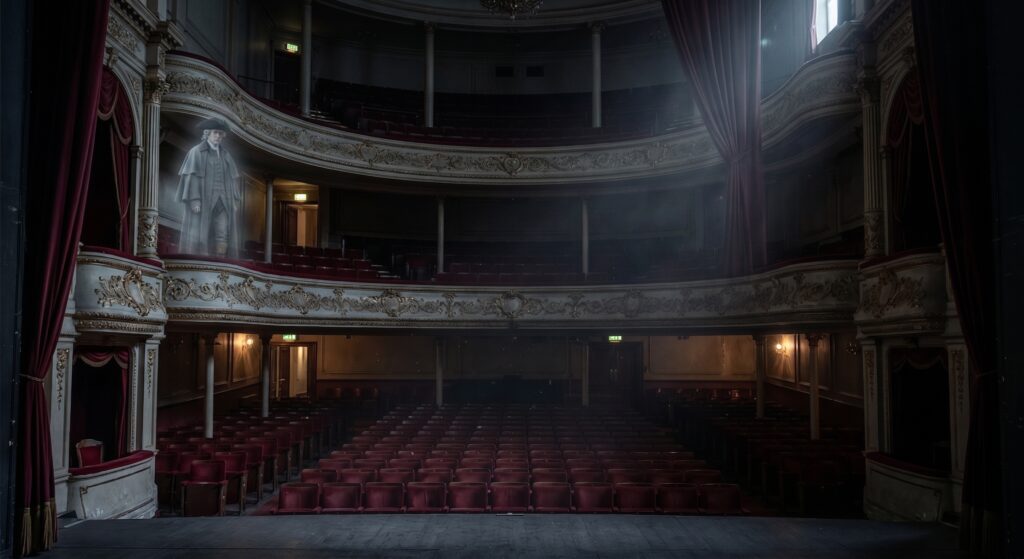
Actors treat these ghosts differently than the rest of us treat the dead. Where you might flee a cold spot in a corridor, a stage manager will nod and carry on. Many West End spirits arrive not as threats but as omens, and the most famous of them signals a hit. That inversion sits at the heart of theatrical haunting. The dead here are colleagues, not intruders. Keep that in mind as we walk the boards, because the story that follows explains why one grey figure remains the most welcome ghost in Britain.
Theatre Royal, Drury Lane: The Valhalla of Theatreland
First raised in 1663, the current Drury Lane stands as the fourth building on a site scarred by fire, upheaval, and a failed assassination of King George III. Many call it the most haunted theatre in the world. It also holds the strange distinction of housing several distinct residents at once, each with a signature and a story.
The Man in Grey
A late-18th-century gentleman strolls the Upper Circle in daylight, which already breaks the ghostly rulebook. He wears a powdered wig, a tricorne hat, a grey riding cloak, riding boots, and a sword. Witnesses watch him settle near the fourth row, walk the gangway, then vanish into a wall beside the Royal Box.
Here is the detail that hardens the legend. During renovations in 1848, workers broke through that exact wall and found a bricked-up passage. Inside lay a skeleton, a dagger still lodged between its ribs, scraps of grey cloth clinging to the bones. Someone had murdered a man and sealed him where nobody would look. The Man in Grey stopped being a rumor that day and became a case.
Casts and crews welcome him. His appearance forecasts box-office success, and he reportedly surfaced before the celebrated runs of Oklahoma! and The King and I. When dozens of the Oklahoma! company saw him at once, the sighting shrugged off easy explanations of a single overtired mind. Whether he steers a show’s fortune or simply feeds the confidence of those who believe, his arrival still changes how a company works.
Joseph Grimaldi, the Guiding Clown
Grimaldi fathered modern clowning, and his spirit haunts the wings with unusual kindness. Actors describe gentle nudges into better vocal positions and playful “comedy kicks” that steer them across the stage. Some report a floating, clown-white face, a chilling image tied to his own macabre dying request. He remains a helper, not a menace, guiding the nervous the way he once guided audiences into laughter.
Dan Leno and the Scent of Lavender
The great Victorian pantomime dame died in 1904. In life he battled chronic incontinence and drowned the smell in heavy lavender oil. Backstage workers now report the sudden, pervasive scent of lavender drifting through empty corridors. From his old dressing room come rhythmic drumming and the crisp beat of clog dancing, as though Leno still rehearses a routine the living cannot see.
Charles Macklin, Bound by Guilt
In 1735, Macklin argued with fellow actor Thomas Hallam over a wig. He drove his cane into Hallam’s left eye, and the wound killed him. Macklin lived to 106, yet his remorseful shade reportedly lingers on the very spot where the violence happened, unable to walk away from a single furious moment.
The Lyceum Theatre: The Ominous Severed Head
The Lyceum hides a far grimmer memory. In the 1880s, a couple in the balcony looked down into the stalls and saw a woman cradling a man’s severed head in her lap. Later telling links the vision to a family beheaded for treason, a family that once owned the very land beneath the theatre. Some accounts also place the ghost of actor-manager Arthur Bourchier on a phantom staircase, appearing during tense moments as if to steady a shaky production.
The Adelphi Theatre: The Revenge of the Understudy
In December 1897, a disgruntled minor actor named Richard Archer Prince stabbed the celebrated William Terriss at the Adelphi stage door. Professional jealousy drove the blade. Terriss died in the arms of his leading lady, and legend has him whispering a promise as he went: he would be back.
He appears to have kept his word. Witnesses place his spirit along Maiden Lane, knocking on dressing-room doors and even drifting through the nearby Covent Garden tube station. A murdered man vowing to return, then apparently returning, gives the Adelphi one of the most quietly unsettling hauntings in London.
More Voices in the Dark
Her Majesty’s Theatre holds Sir Herbert Beerbohm Tree, who lived in its dome and died in 1917. He watches from a stage-right top box while freezing drafts sweep past and doors swing on their own. The Dominion Theatre rises on the site of the 1814 London Beer Flood, and the ghost of 14-year-old victim Eleanor Cooper reportedly sits giggling in the empty auditorium. At the Victoria Palace Theatre, poltergeist activity, including flying wigs and locking doors, gets blamed on the wartime removal of a statue of ballerina Anna Pavlova.
What the West End Remembers
A pattern runs through all of it. These spirits cluster where emotion ran hottest and where the buildings changed most violently. Fire, murder, sudden loss, then a renovation that pries open a hidden wall. The West End does not simply host ghost stories. It preserves the people who could not bear to leave, and it keeps a seat warm for the ones who bring good luck. The final curtain, it seems, is rarely final here.
References & Further Reading
Wikipedia, Theatre Royal, Drury Lane. https://en.wikipedia.org/wiki/Theatre_Royal,_Drury_Lane
Spooky Valley, Haunting at Drury Lane Theatre. https://spookyvalley.com/events/haunting-drury-lane-theatre/
True Ghost Tales, Ghosts of Drury Lane Theatre. https://trueghosttales.com/drury-lane-ghosts/
A London Inheritance, The Ghosts of London. https://alondoninheritance.com/london-characters/the-ghosts-of-london/
Pardon My French Theatre Blog, Favourite Theatre Ghost Stories. https://pardonmyfrenchtheatreblog.wordpress.com/2014/10/31/something-wicked-this-way-comes-our-favourite-theatre-ghost-stories/
Haunted London, London’s Haunted Theatres. http://haunted-london.com/haunted-london-theatres.html