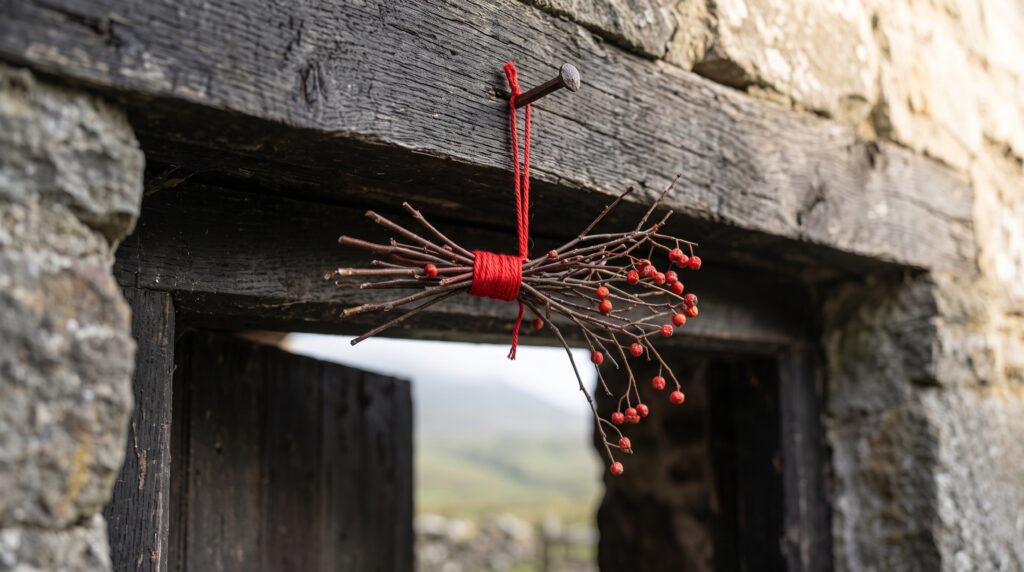
A horseshoe hangs above the door of a farmhouse in rural Ireland. A small blue glass eye, strung on a red cord, dangles from the rearview mirror of a taxi in Istanbul. Salt sits in a dish near the entrance of a home in the American South. Above a stable door in Scotland, a rowan twig tied with red thread hangs.
These are not decorations. Each of them is, or was understood to be, a defense against something.
The word for this practice is “apotropaic,” from the Greek “apotropein,” meaning “to turn away.” Apotropaic objects, symbols, and rituals are designed to deflect, repel, or neutralize malevolent supernatural forces before they can enter a person’s space, body, or life. The tradition predates recorded history, appears on every inhabited continent, and continues in recognizable forms today. What it tells us about human fear is worth understanding in its own right.
The Vulnerable Points
Apotropaic belief across cultures begins with the same assumption: certain spaces and moments face greater exposure to supernatural threat than others. The threshold, the doorway, the window, the hearth opening, the keyhole—these are passages between inside and outside, between the known and the unknown. They require protection precisely because they cannot be sealed.
Folklorist Icy Sedgwick has written about the home as a spiritually significant space in European folk tradition, noting that the development of the interior home changed people’s relationship with the supernatural world outside. As rooms multiplied and home life became more private, the threshold accumulated protective significance. Whatever crossed it needed to be managed.
This is why so much apotropaic practice focuses on entry points. The horseshoe above the door. The witch marks were scratched into lintels and hearthstones. The shoes concealed within walls when a building was constructed. The rowan tree planted beside the gate. Protection was not applied uniformly to the entire structure. It was concentrated where the barrier between inside and outside was permeable.
Iron: The Metal That Repels
Iron occupies a singular position in European apotropaic tradition. Across Celtic, Scandinavian, Germanic, and Slavic folklore, iron was understood as inherently hostile to supernatural forces. Fairies could not tolerate it. It turned witches back. Spirits recoiled from its presence.
The horseshoe became perhaps the most widespread apotropaic object in the Western world partly because it combined the protective properties of iron with a shape associated with the moon and with luck. Nailed above a door with the points upward, it was believed to catch and hold good fortune. Nailed with the points downward, it was thought to pour blessings on those who passed beneath it.
Historical records of horseshoe orientation suggest regional variation in belief, but the underlying principle remained consistent: iron was a barrier between the human world and whatever moved beyond it. A horseshoe above the threshold announced that the household was defended.
Crossed iron objects, knives laid in front of doorways, iron nails driven into specific structural points, and iron tools carried on the person appear in protective folklore across Northern and Western Europe. The material was the mechanism. Where iron was present, certain things could not go.
Salt: Purification and Boundary
Salt appears in protective folklore on every inhabited continent, which places it among the most universally distributed apotropaic materials in human history. Its preservative properties, which prevent organic decay, appear to have transferred conceptually into a belief in its ability to preserve spiritual integrity and resist corruption.
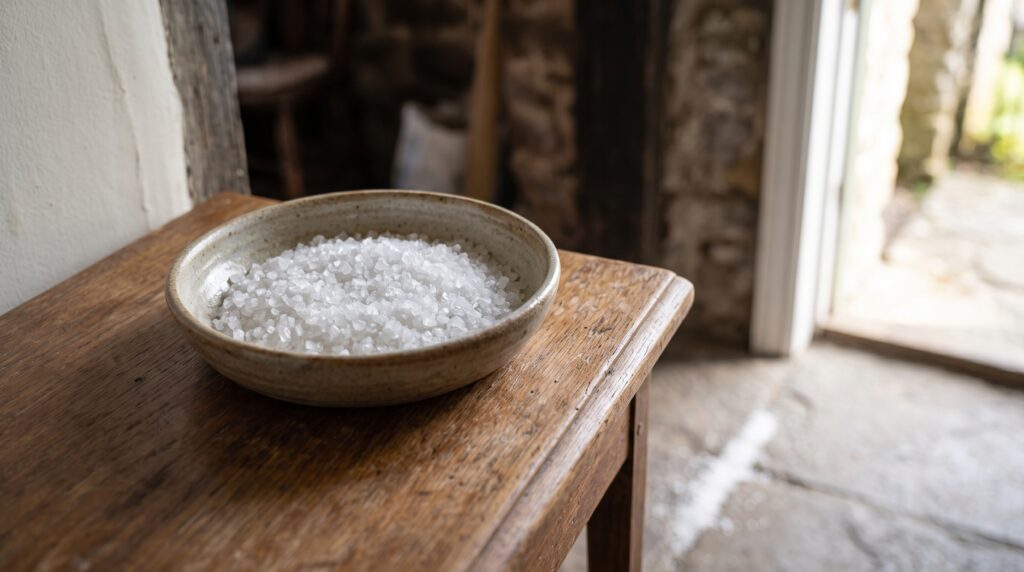
In Slavic folk tradition, bread and salt kept near the entrance provided protection against ill-intentioned visitors, human and otherwise. Japanese Shinto practice uses salt to purify spaces before rituals and to mark the boundaries of sacred sites. In Western esoteric traditions, salt circles were believed to form barriers that spirits could not cross.
The salt-as-boundary concept appears in contemporary practice as well: salt poured in lines across doorways, salt in the corners of rooms, and salt scattered after a difficult event to clear the energy the event left behind. The specific framework varies by tradition, but the underlying logic, that salt marks and defends a boundary, remains recognizable across contexts.
Botanical Protections: Rowan, Rue, and the Language of Plants
Plants with apotropaic properties form a distinct category in folk protection traditions, and the specific plants named vary significantly by region and cultural context.
In Celtic traditions, the rowan tree was sacred and powerful. Twigs tied with red thread and hung above doors, cradles, and stables were believed to repel witches and malevolent spirits. The red berries of the rowan may have contributed to its protective associations: red was consistently linked with life and defense against the evil eye across European and Mediterranean traditions.
Rue, an aromatic herb with a bitter taste, was used in Mediterranean and Southern European folk practice both as a protective charm and as a treatment for having already been affected by the evil eye. Sprigs of rue hung at doorways or worn on the person were thought to deflect harmful intentions.
St. John’s Wort carried protective associations in both European folk tradition and in early Christian practice, where it was associated with light and the midsummer feast of John the Baptist. Its yellow flowers, blooming at the height of summer, linked it symbolically to solar energy and the dispelling of darkness.
The Evil Eye and Reflective Defense
The evil eye, a belief that envy or malice can cause harm through a specific kind of directed look, may be the most widely distributed supernatural threat concept in human history. Evidence of evil eye belief and protective responses appears in ancient Egyptian, Mesopotamian, Greek, Roman, Arab, South Asian, Sub-Saharan African, and Latin American cultures, among many others.
The protective response to the evil eye is typically to deflect or redirect it, often through a mirroring strategy. The nazar, a blue glass eye amulet most associated with Turkish and Greek tradition, is designed to catch the evil eye’s look and reflect it back to its source. The eye-shaped design confronts the attacking gaze directly.
Greek drinking vessels from the 6th century BCE were painted with exaggerated eyes on their exteriors, a practice believed to prevent evil spirits from entering the drinker’s mouth. Mediterranean fishing boats continued to carry painted eyes on their bows into the modern era.
The gesture of knocking on wood, still performed reflexively by people who do not identify as superstitious, is likely a descendant of apotropaic tree-touching traditions that invoked the protective spirit believed to inhabit wood. The Yiddish expression “kain ein horeh,” meaning “no evil eye,” performs a similar function verbally: naming and negating the threat simultaneously.
Witch Bottles and Buried Objects
Among the most striking apotropaic traditions in early modern England and North America is the witch bottle: a sealed vessel, typically containing pins, nails, human hair, and urine, buried beneath the threshold of a home. The pins and nails were believed to cause pain to any witch or spirit that attempted to cross the threshold; the owner’s biological material anchored the protection to the specific household.
Archaeological excavations of homes from the 16th through 18th centuries across England and the American colonies have uncovered witch bottles, dried cats, shoes, and horse skulls concealed in walls, floors, and chimneys. These objects were placed during construction or renovation, invisible to the occupants of the finished home but understood to be working constantly on their behalf.
The concealed shoe, in particular, appears so frequently in English architectural archaeology that it has generated dedicated scholarly study. Shoes were intimately associated with the person who wore them, and their concealment in a building’s structure was thought to trap or misdirect any entity that entered the space.
Why Apotropaic Belief Persists
Contemporary people who hang horseshoes, carry evil eye amulets, knock on wood, or place salt at doorways generally do not articulate a coherent theological framework for these practices. Many would describe them as habits, as something their family has always done, or as fun rather than serious.
Such behavior is precisely how apotropaic traditions survive. They do not require belief in the specific mechanism to remain culturally persistent. The practice is embedded in routine, in aesthetics, in the social meaning of objects passed from family members who are now gone. A grandmother’s blue eye amulet in the rearview mirror carries her presence as much as it carries any protective intent.
The need to feel defended against uncontrollable forces remains constant. The specific objects and the specific threats they address change with culture and era. But the instinct to mark a threshold, place something protective between inside and outside, and carry something that announces your defense is as old as any record of human life.
The horseshoe is still above the door. Whatever it is keeping out has not stopped trying to get in.
References & Further Reading
Icy Sedgwick: Home Protection the Folklore Way
Panaprium: The Forgotten Folk Charms Our Ancestors Used for Protection
Charles Fairey Historian: Protective Devices, Apotropaic Symbols and Witch Marks