Some Columbus legends come with newspaper clippings and historical markers. This one comes with almost nothing, and that is precisely why it is worth an honest look. The story of a British prisoner camp on a Scioto River sandbar, sometimes called British Island, floats mostly on oral tradition. Rather than dress it up, let us separate the sturdy history from the mist.
The legend
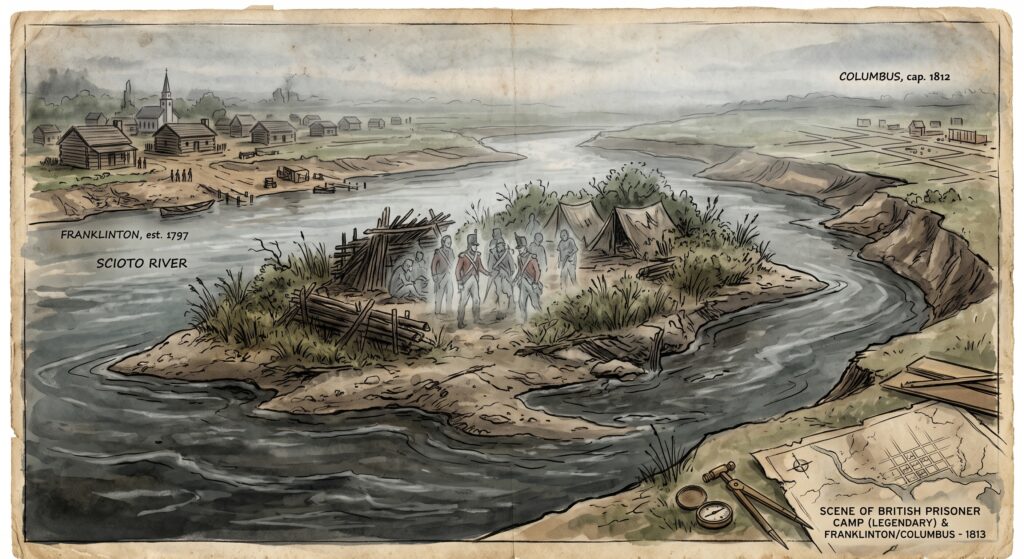
The tale describes a small island or sandbar in the Scioto River near early Columbus. It supposedly held prisoners of war during the War of 1812, with ghosts of soldiers said to linger. Local historians have discussed British Island and other vanished Scioto sandbars, noting the river once ran narrower and deeper than it does now.
A word of caution on the record
Solid, widely available documentation for a formal War of 1812 POW camp on a specific Columbus sandbar is thin. The legend appears in local tellings more than in primary archives. That does not make it false, but it means we should hold the specifics loosely and lean on what we can actually verify.
The verifiable backdrop
The setting, at least, is well documented. Surveyor Lucas Sullivant platted Franklinton on the west bank of the Scioto in 1797, the first American settlement in the area. When Ohio chose the east bank for its new capital in 1812, the year the War of 1812 began, Columbus was laid out from scratch. Franklinton flooded often, and the Scioto’s shifting channel created and erased sandbars over time.
So a frontier settlement, a new capital, a war, and an unstable river all coincided here. That real convergence gives the island legend a plausible stage, even if the camp itself resists proof.
How thin legends survive
Stories like British Island endure because they sit at the edge of memory, too specific to dismiss, too undocumented to confirm. They preserve a fragment of frontier anxiety, of a young capital wedged between a hostile war and a temperamental river.
Treat this one as folklore with a factual frame. The Scioto sandbars were real, Franklinton and early Columbus were real, and the War of 1812 shaped the moment the city was born. The prison camp is the ghost in the story, unproven and elusive, which is oddly fitting for an island the river may have long since washed away.
References & Further Reading
History Lesson: Lucas Sullivant, Pioneer of Franklinton, Columbus Underground