A French curse that crossed an ocean, changed its name through a quirk of language, and learned to howl in the bayou.
Here is a linguistic riddle. How does loup-garou become rougarou? A Cajun folklorist has the answer, and it explains far more than a spelling change.
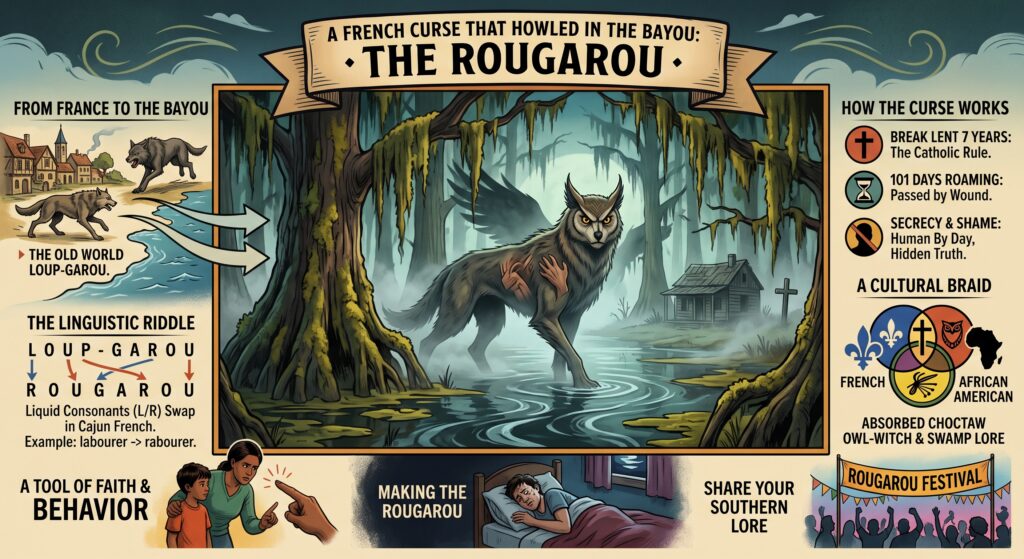
In the swamps of southern Louisiana, parents still warn children that the rougarou will come for them. The beast punishes the disobedient and the faithless. Behind the scares sits a rich braid of French, Catholic, and Indigenous influence.
From France to the Bayou
The legend begins in sixteenth-century France with the loup-garou, literally the wolf-werewolf. In rural France, people blamed the creature for missing children, ransacked homes, and dead livestock. French and French-Canadian settlers carried the tale to Louisiana.
The name shifted along the way. Folklorist Barry Jean Ancelet explains that l and r are liquid consonants that swap easily in Cajun French. Loup-garou slid into rougarou the same way labourer becomes rabourer in local speech. The monster changed its name through a natural feature of the dialect, not through invention.
How the Curse Works
The classic curse targets faith. Break the rules of Lent for seven straight years, the story says, and you become a rougarou. A separate blood legend adds a grim twist. The afflicted roam for a set span, often given as one hundred and one days. Then they pass the curse to whoever they wound.
Secrecy runs through it. The cursed person, briefly human again by day, hides the truth for fear of being killed. That detail turns the myth inward, making it about shame as much as monstrosity.
A Tool of Faith and Behavior
The rougarou did practical work in Catholic Cajun country. Elders used it to keep children in line and to enforce religious observance. Behave, or the beast comes. Keep Lent, or you become the beast.
The creature even lives in everyday speech. In parts of Terrebonne and Lafourche, a restless, sleepless night is called making the rougarou. To carouse and roam at night is to faire loup-garou. The monster became a verb.
A Convenient Scapegoat
In rural France, the loup-garou did dark social work. People blamed it for crimes and misfortunes, from ransacked houses to missing children. Some accused neighbors even faced trials for supposed lycanthropy. The beast offered an explanation for tragedy and a target for suspicion.
That function traveled to Louisiana intact. The rougarou absorbed local Native American shapeshifter traditions and African American swamp lore, becoming a uniquely Cajun blend. Folklorist Barry Jean Ancelet reads it as an image of dual identity, a foot in two worlds, fitting for a people living between French and Anglo-American cultures.
Not Quite a Hollywood Werewolf
This is where the rougarou stops resembling the silver-screen werewolf. Because wolves are scarce in the region, many Cajuns describe the creature as dog-like or even owl-like. The rougarou absorbed local Indigenous shapeshifter traditions, including a Choctaw owl-witch figure. That respectful borrowing gave it a distinctly Louisiana shape.
The full moon and silver bullets barely feature. The rougarou answers to faith, sin, and the swamp, not the silver screen.
Share Your Southern Lore
Today the rougarou anchors festivals, museum exhibits, and a whole tourism identity. Louisiana may be the only place where a monster that punishes misbehavior also headlines a party.
References & Further Reading
Rougarou Louisiana Swamp Monster, Atlas Obscura
Curious Louisiana: Where did the rougarou come from?, The Advocate

[…] Road have persisted since the 1980s. Down in the bayous of Louisiana, Cajun tradition warns of the Rougarou, a werewolf-like creature that enforces Catholic Lenten rules and terrifies misbehaving […]