A glow on the rails
Near the small town of Gurdon in southwestern Arkansas, a ghost light haunts a stretch of railroad tracks. Witnesses describe a glowing orb, white or bluish in color, that appears down the line and sways as if someone were carrying a lantern. The Gurdon Light is one of Arkansas’s most famous unexplained phenomena and a steady magnet for curious visitors.
The light reportedly appears in various weather conditions and has been observed for many decades. Its swinging, bobbing motion strongly suggests a hand-carried lantern, which fits perfectly with the tragic legend attached to it. The remote, wooded setting along the tracks gives the Gurdon Light an especially eerie and isolated atmosphere.
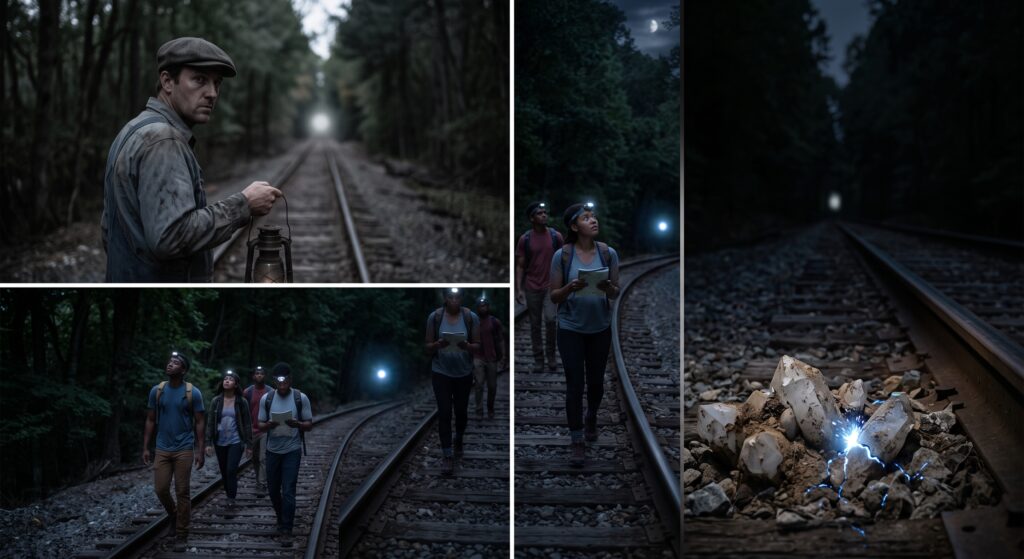
Reaching the light requires a walk along the tracks, away from roads and streetlights. That effort enhances the experience and the feeling of exploring the unknown. Visitors have made the trek for generations, especially around Halloween, to see the famous glow for themselves.
The 1931 murder legend
The classic story ties the light to a real and documented event. In 1931, a railroad worker named Louis McBride reportedly murdered a foreman named William McClain near the tracks. The two clashed over work and pay during the Great Depression. The crime genuinely occurred in the Gurdon area.
The legend says the Gurdon Light is McClain’s restless ghost, or occasionally a decapitated rail worker, wandering the line with a lantern. The spirit is said to be forever bound to the scene of the tragedy. The connection provides the light a specific, named origin rooted in local history.
A murder did occur in that era, which provides this legend more historical grounding than most ghost-light tales enjoy. Still, the connection between the documented crime and the light itself remains folklore. The decapitation detail again echoes the broader Southern railroad-ghost tradition, suggesting embellishment layered onto a real event.
The piezoelectric theory
Gurdon offers an unusually compelling scientific angle that sets it apart from other ghost lights. The area sits near a geological fault. Some researchers propose that quartz crystals in the rock, squeezed by tectonic pressure, could generate a piezoelectric charge and produce visible light at the surface.
This would make the Gurdon Light a rare natural earth-light phenomenon rather than refracted headlights. The piezoelectric idea is compelling partly because the light sits in a spot with little through traffic. That location weakens the usual headlight explanation that solves so many other ghost lights.
Others still suggest swamp gas or distant lights as the cause. No theory has been definitively confirmed. But the geological explanation gives Gurdon a distinctive place among American ghost lights, tying its glow to the restless ground itself rather than to passing cars. That possibility makes it a favorite among researchers.
Seeking the light
The Gurdon Light appears along tracks reachable only on foot, so visitors should use real caution. Respect active rail lines and private property, and never walk the tracks carelessly, since trains do still run. Safety matters more than any sighting.
The light may be a genuine geological earth-light, a distant refracted source, or something still unexplained. Its documented 1931 murder legend and its intriguing piezoelectric theory make it one of the more scientifically compelling ghost lights in the entire country.



[…] Further west, Tennessee claims the infamous Bell Witch of Adams, while Arkansas locals still look for the Gurdon Light. […]