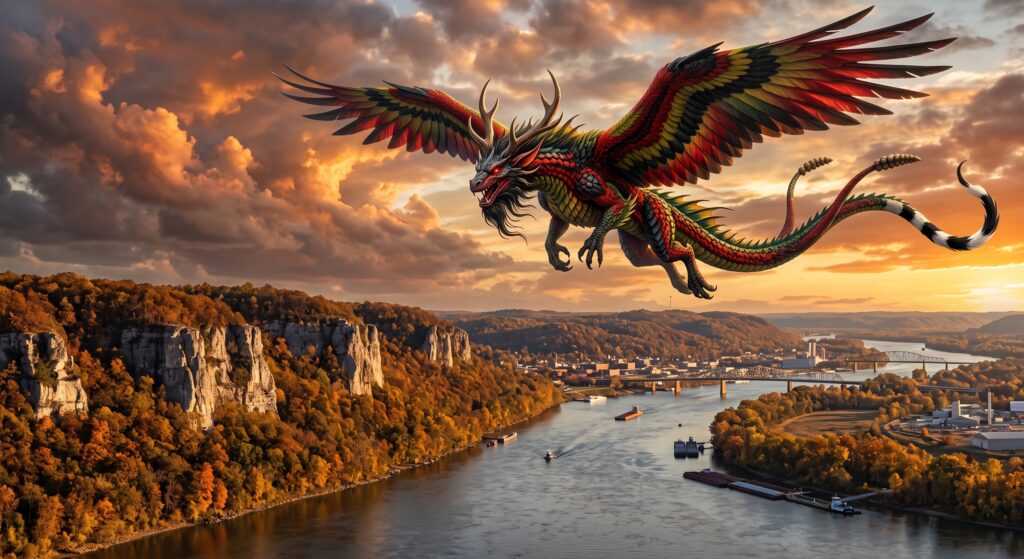
High on the limestone bluffs near Alton, Illinois, a painted creature watches the Mississippi River. Known as the Piasa Bird, it appears as a fearsome winged beast with horns, a scaled body, and a long tail. A modern mural recreates it in bright colors, and travelers along the river road stop to photograph the striking image.
The legend and the painting draw on genuinely old roots. In 1673, French explorers Jacques Marquette and Louis Jolliet recorded seeing painted monsters on the bluffs during their journey down the Mississippi. Marquette described large painted creatures that reportedly frightened the Native peoples of the region. That account is the earliest written record of the image.
Marquette wrote that the paintings were so well done that they seemed beyond the skill he expected, and that the creatures were as large as calves. His journal fixed the image in the historical record. The bluffs above the river have carried some version of the painted beast ever since.
What Marquette actually saw
Here is where care is needed. Marquette’s original description does not match today’s popular Piasa image exactly. He described creatures with deer-like horns, red eyes, a beard, a body covered in scales, and a long tail wrapped around the body. He did not clearly describe wings in the way modern versions prominently show.
The winged, bird-like features of the modern Piasa grew in later retellings and recreations. The original rock paintings eroded over time or were destroyed by limestone quarrying in the 1800s. Nothing of the genuine 1673 art survives on the bluffs today.
The version travelers see now is a modern recreation, painted in the 20th century and based on later interpretations rather than a direct copy of the original. We separate the ancient Native image from the modern mural because the two are genuinely not the same thing, despite how the site presents them.
The invented backstory
A dramatic legend attached to the Piasa in the 1800s tells of a man-eating monster that terrorized a Native village. In the story, a brave chief named Ouatoga defeated the beast using warriors armed with poisoned arrows. This tale appeared in a 19th-century writer’s account and spread widely across the region.
Scholars now believe much of this story was invented or heavily embellished by that later writer, a man named John Russell. It was not a genuine tradition passed down from the Native peoples who made the original painting. The dramatic monster narrative is largely a work of 19th-century imagination.
This is a recurring pattern in American folklore. A real Native artwork gets wrapped in a fictional adventure story by a later, non-Native author. The tale is entertaining, but presenting it as authentic Indigenous tradition would be inaccurate. The honest version credits the genuine ancient painting and flags the added fiction clearly.
Visiting the bluffs
The Piasa mural sits along the Great River Road near Alton, an easy and scenic stop with parking nearby. The drive along the Mississippi bluffs is beautiful in its own right, especially in fall. Interpretive signs tell the site’s story.
View the mural for the genuine history of river exploration and Native rock art. The dragon is a striking recreation worth seeing. The man-eating-monster tale of Ouatoga is largely a 19th-century invention, and knowing that makes the real, more subtle history richer rather than poorer.