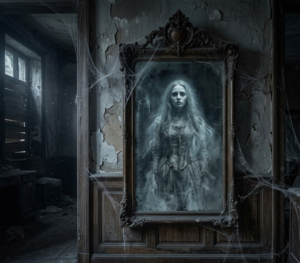
Search for a specific “Dogfish Creek phantom” in Delaware, and the trail runs cold fast. No historical society, folklore archive, or local newspaper has documented a legend by that exact name attached to a specific waterway. What does exist, once the search broadens even slightly, is something better. Delaware has a genuine cluster of water-spirit and phantom folklore tied to creeks, ponds, and inlets across the state, but it is mostly scattered.
Delaware’s relationship with water runs deep, literally and culturally. Between its bay coastline, its inland creeks, and its Lenape heritage, the state has quietly built up a body of water-ghost lore that rivals anywhere in the country.
Maggie’s Bridge: A Creek Legend Hiding in Plain Sight
The most well-documented version of this folklore centers on a stretch of Route 78 near Seaford, at a crossing locals call Maggie’s Bridge, or Old Maggie’s Bridge. According to accounts collected by Only In Your State, the legend tells of a pregnant woman named Maggie who was traveling by carriage when her horse spooked, throwing her into the creek below. She was beheaded in the fall.
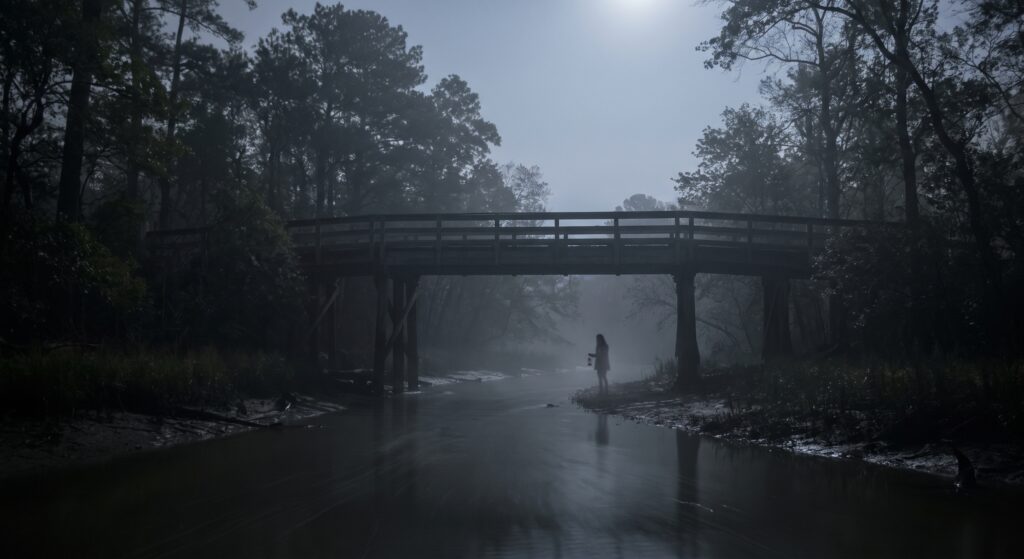
Local tradition holds that visitors who get out of their cars and call out “Maggie, I have your baby” will trigger some form of paranormal response. Technical.ly’s coverage of Delaware’s most-viewed ghost content named Maggie’s Bridge the state’s most popular haunted location in a recent year, driven largely by viral video attempts at the ritual. Despite that popularity, most coverage frames the story as a “crybaby bridge” legend rather than what it fundamentally is: a creek phantom story tied directly to the water beneath the bridge rather than to the bridge itself. See our other posts on crybaby bridges in Alabama and Texas.
The Sea Witch and Molly McGwinn
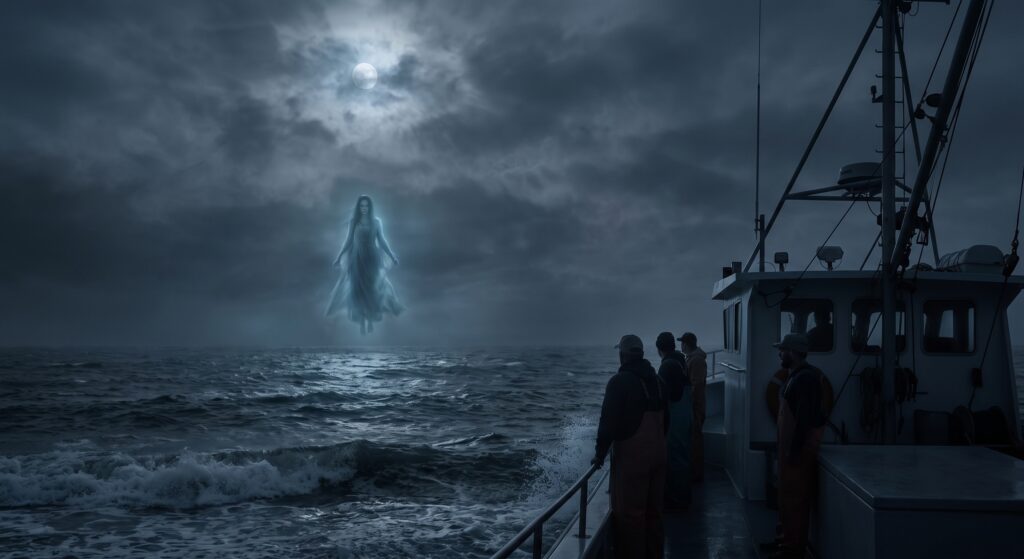
Delaware’s coastal folklore adds two more water-bound spirits to the pattern. The wreck of the DeBraak, a British warship that sank off the Delaware coast, is said to be guarded by a phantom called the Sea Witch. Local fishermen have reported seeing the apparition, which reportedly issues warnings to stay away from the wreck site before vanishing, according to folklore documented by Visit Rehoboth.
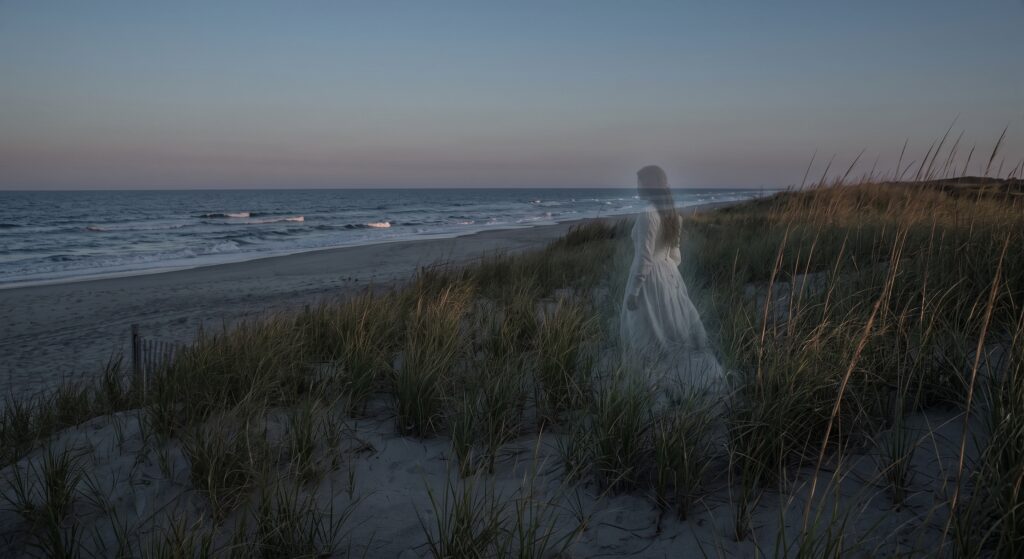
At Delaware Seashore State Park, a separate legend describes Molly McGwinn, a woman in white seen wandering the dunes near Indian River Inlet. Tradition holds that Molly drowned herself in the ocean generations ago, and staff and visitors still report seeing her figure at dusk. Both stories share a structure with the Maggie’s Bridge legend: a woman, a body of water, and a death that predates any written record.
The DeBraak itself is a documented piece of history, not folklore. The British warship sank in a squall off Cape Henlopen in 1798, and its wreck sat undiscovered until a 1986 salvage operation raised the hull, sparking a long legal and archaeological dispute over the ship’s contents. That real, well-documented disaster is likely what seeded the Sea Witch legend in the first place, giving the ghost story a physical anchor that many folklore tales never get.
Lums Pond and the Lenape Water Tradition
Further inland, Lums Pond in New Castle County carries its own water-ghost reputation. Visitors report hearing screams believed to come from a girl killed near the pond in the 1800s, a story that persists locally despite thin documentation. These pond and creek legends form a loose network across the state rather than a single, isolated tale.
It is worth noting separately that the Lenape people hold water spirit traditions of their own. Their traditional homeland includes present-day Delaware, and their stories describe beings that live in deep water, treated with genuine spiritual significance within Lenape culture, as recorded in broader Indigenous water-legend traditions. Those traditions are living cultural and religious beliefs, not folklore invented for entertainment, and they deserve to be understood on those terms rather than folded into secular ghost-story content.
A Pattern Older Than Any Single Legend
Water-ghost stories tend to follow a shape that shows up worldwide: a spirit tied permanently to a specific body of water, usually connected to a death that happened at or near that water. Rivers, creeks, and coastlines make natural settings for this kind of folklore because water itself resists closure. A body lost to a river or a bay does not always remain, and that lack of resolution seems to be what keeps these stories alive across generations.
Delaware’s version of this pattern spans the entire state, from the tidal creek beneath Maggie’s Bridge in Sussex County to the ocean dunes at Indian River Inlet to an inland recreational pond in New Castle County. That geographic spread suggests something closer to a shared regional folklore tradition than four disconnected local legends that happen to involve water.
Why This Cluster Stays Unmapped
Each of these stories, Maggie’s Bridge, the Sea Witch, Molly McGwinn, and Lums Pond, gets covered individually, usually as a single entry on a broader “haunted Delaware” roundup. Almost nothing treats them as what they actually are: a connected regional pattern of water-spirit folklore specific to Delaware’s creeks, ponds, and coastline.
That gap is worth filling, even without a documented “Dogfish Creek” legend to anchor it. Delaware’s real water folklore does not need an invented location. It already has a beheaded bride, a shipwreck guardian, a grieving figure in the dunes, and a screaming girl at an inland pond. Those four stories share a common thread nobody has bothered to draw a line through until now.
References & Further Reading
Bridges In Delaware: Maggie’s Bridge Is A Haunted Road — Only In Your State
Maggie, Maggie: Delaware’s spookiest ghost videos — Technical.ly
Coastal Delaware Ghost Stories — Visit Rehoboth
Native American Indian Water Legends — Native Languages of the Americas