Beneath Wisconsin’s loudest football tradition lies the northernmost Confederate graveyard in America. Every home game, more than 80,000 fans from Wisconsin jump in unison to music near the end of the third quarter. The stands physically shake. It is one of the most joyful traditions in college football. This celebration takes place on the site of a Civil War prison camp.
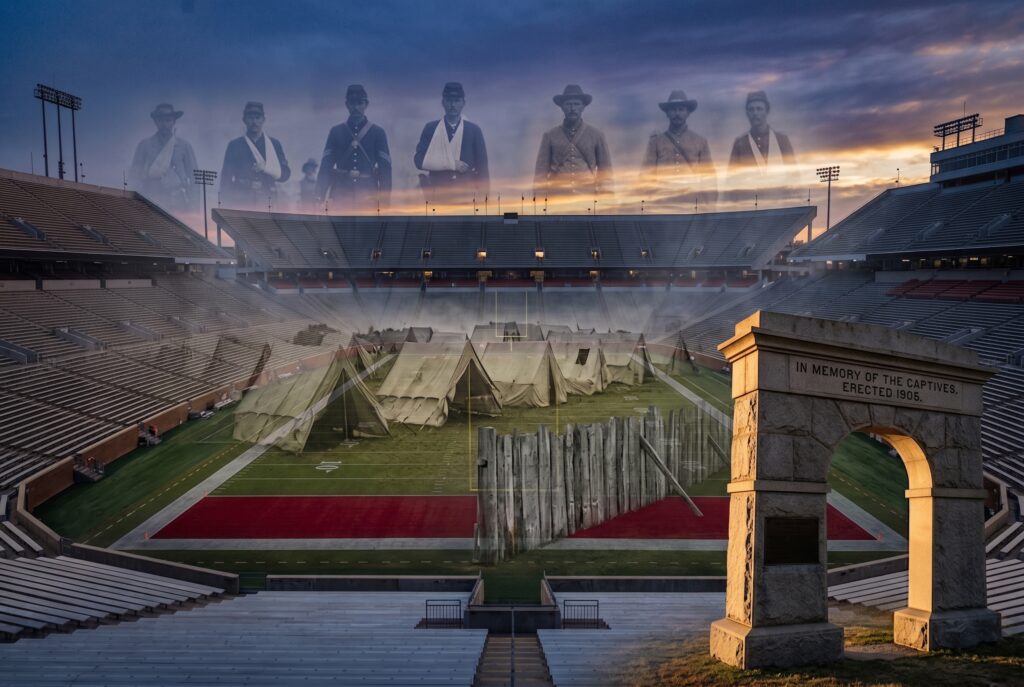
That collision, pure celebration stacked directly on top of wartime suffering, is what gives Camp Randall its strange power. Before the Badgers, before the roar, this ground held dying men far from home. The same earth that trembles under a stadium full of jumping students once held the sick and the imprisoned.
Almost none of the fans know it. That gap between the joy above and the history below is the real haunting here, and it does not require a single ghost to feel it.
From fairgrounds to fortress
The site began as state fairgrounds. When the Civil War broke out, Wisconsin’s governor turned it into a training camp named for himself, and roughly 70,000 Union recruits drilled here before marching south. For a brief, brutal stretch in 1862, it became something darker: a prison.
After the Union victory at Island Number 10 on the Mississippi, about 1,200 captured Confederate soldiers were shipped north to Camp Randall, most of them from the 1st Alabama Infantry. Many arrived already sick or wounded, some carried in on stretchers after an eight-day boat trip up the river.
The site was never designed to hold captives. It had trained soldiers, not imprisoned them. Overnight, a boot camp became a stockade, and the transformation went badly from the start. Madison residents, oddly, met the arriving prisoners with curiosity and even sympathy rather than hostility, donating supplies to ease their suffering.
That local kindness is one of the more surprising threads in the story. These were enemy soldiers in wartime, yet the town treated many of them as suffering men first. Residents brought food and supplies to the fence. It is a small, human detail that complicates the usual picture of a prison camp, and it foreshadows the care Alice Waterman would later show the graves.
The men who never went home
The camp was never built to hold prisoners, and it showed. The fence was poor, the guard unit inexperienced, and the hospital overwhelmed. Within weeks the newspapers listed the dead each morning, most lost to fever and disease rather than any violence. By the time the survivors were shipped to Chicago at the end of May, roughly 140 Confederates had died here.
They were buried in Madison’s Forest Hill Cemetery, in what became Confederate Rest, the northernmost Confederate burial ground in the nation. These were men from Alabama, Tennessee, Mississippi, Louisiana, and Arkansas, laid to rest hundreds of miles from any place they knew.
A Louisiana-born local woman, Alice Whiting Waterman, later tended those graves for some 35 years, an unlikely act of care for the enemy dead. She took it upon herself to keep the plot, and the state eventually recognized her devotion. In a story full of neglect, hers is a rare note of tenderness.
The prisoners themselves left few traces beyond a list of names and a shaded plot of graves. Most were young, poor, and far from any home they would see again. They did not choose this fight or this frozen northern ground. History remembers the battles they came from, but rarely the quiet, feverish way so many of them actually died, listed one by one in a Wisconsin newspaper each morning.
The soldiers who march on game day
The hauntings match the history. Witnesses describe spectral figures in Civil War uniforms crossing the field late at night or lingering in the stands. Some appear to wear hospital dressings over their wounds, a chilling echo of how they died. Tailgaters have reported them most often on cold game-day mornings, wandering the grounds where they perished.
A separate figure drifts through the nearby cemetery: a lady in white in a wide hoop dress, mourning someone unknown. Some wonder whether Alice Waterman never truly left the soldiers she cared for, and whether her devotion outlasted her life. The idea is romantic, and impossible to confirm.
These accounts remain unverified, as ghost accounts always are. No apparition needs to be real for the site to unsettle you. The documented history underneath the legends is heavy enough on its own. The uniforms and the wounds are not invented. Only the marching is in doubt.
A monument hiding in plain sight
Most fans stream into the stadium through the Camp Randall Memorial Arch without a glance. The arch honors the site’s Civil War past, and a small memorial park preserves what remains, including a surviving guardhouse. The land is on the National Register of Historic Places, called the single most important Civil War site in Wisconsin.
That is the real haunting here, and it does not require a single ghost. It is the fact that a place of imprisonment, disease, and death became a place of pure Saturday joy. And that almost no one jumping in the stands knows the ground beneath them once listed its dead in the morning paper.
The soldiers who suffered here are remembered by a quiet arch and a shaded plot of graves across town. The living remember something else entirely: touchdowns, traditions, and a stadium that shakes. Both memories are true, on exactly the same ground.
Perhaps the fairest way to hold both is to keep jumping and keep knowing. The joy does not dishonor the dead. The forgetting might. Camp Randall asks nothing more than that its two lives be remembered together, the celebration and the sorrow sharing a single field.
The university has taken small steps toward that balance. The Memorial Arch stands at the entrance, and a modest marker notes the camp’s wartime past. Yet these tributes are easy to walk past on a game day, drowned out by marching bands and tailgate crowds. History competes poorly with a kickoff. The challenge is not building more monuments. It is persuading eighty thousand celebrating fans to spare a thought, just once, for the sick and captured men who died on the ground now shaking beneath their feet.
References & Further Reading
UW-Madison, Camp Randall Prison Camp