A secondhand account of the Kongamato reached the Prince of Wales in 1925, decades before anyone suggested a stork could explain it
A Story That Reached a Future King
A future king once heard this story firsthand, and it apparently unsettled everyone in the room. That detail rarely makes it into modern retellings of the Kongamato, Central Africa’s winged terror of the swamps, but it belongs at the center of the legend.
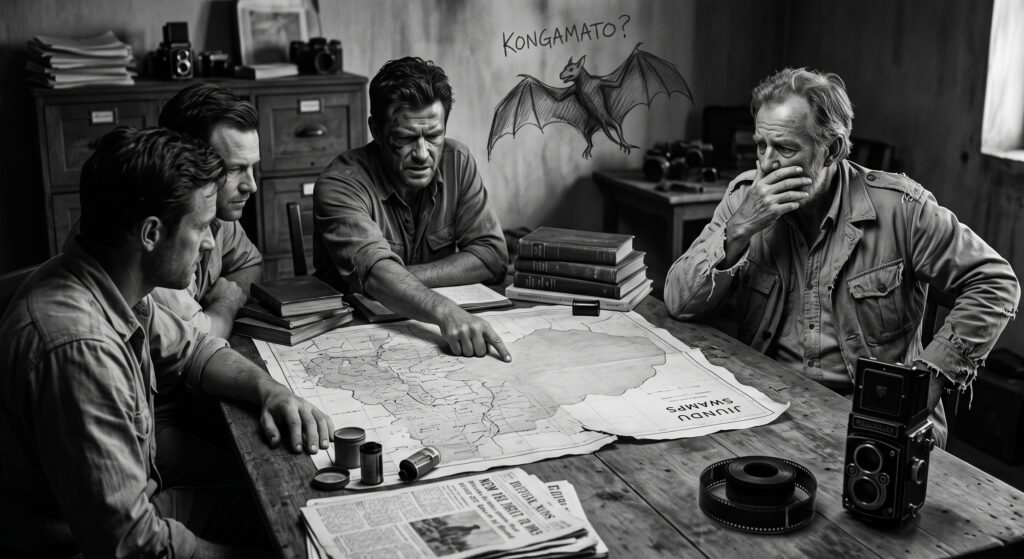
Sporadic reports of the creature kept surfacing through newspapers and travel journals across the 1940s and 1950s, decades after the original account. Yet no photograph, bone, or track has ever backed up a single one of them. That gap between a persistent story and an empty evidence file is exactly what makes this cryptid worth examining carefully rather than dismissing outright.
The Overturner of Boats
The Kongamato takes its name from the Kaonde language of Zambia, where it is translated as “overturner of boats.” British colonial administrator Frank Melland documented the creature in his 1923 book In Witchbound Africa, drawn from his time stationed near the Jiwundu Swamp. Local accounts described a large, reddish, featherless creature with leathery bat-like wings and a long beak lined with sharp teeth. It preferred dusk hunting, swooping low over rivers to attack canoes and the fishermen inside them. Communities in the area reportedly feared it more than lions or crocodiles, treating it as an omen of death rather than an ordinary predator.
Melland’s book was an ethnographic study of Kaonde tradition, not a scientific expedition report. That distinction matters. He was recording belief and oral history as a colonial administrator interested in local culture. He was not conducting a zoological survey with the tools to confirm or deny a living species. His account gave the Kongamato its name and its first written description, but it never claimed to prove the creature’s existence.
A Royal Audience and a Terrified Witness
The story gained an unusual boost two years later. In 1925, journalist G. Ward Price was traveling in Rhodesia with a royal delegation that included the Prince of Wales, later King Edward the Eighth. A local civil servant told the group about a man who had wandered into a swamp known locally as a haunt of demons. He returned badly wounded, with a deep gash across his chest. The man described a huge, long-beaked bird that had attacked him without warning. The civil servant then showed him a picture of a pterosaur from a book of prehistoric animals. The man reportedly screamed and fled the house rather than look at it again.
That reaction is the detail worth sitting with. This was not a case of a Western investigator planting an idea and then confirming it against the same picture. That pattern is closer to how stegosaur and ceratopsian identifications sometimes worked elsewhere in Congo cryptid history. Here, the picture was shown after the man had already described his attacker, and his terror suggests genuine recognition rather than polite agreement. A royal audience heard this account secondhand and, by most retellings, found it unusually convincing for a colonial-era travel anecdote.
The Bird That Already Looks Prehistoric
Reported wingspans for the Kongamato generally range from four to seven feet, modest compared to some inflated later tellings that stretch the figure toward absurdity. That more conservative range happens to land close to a real, living bird found in exactly the same swamps.
The shoebill stork is one of Africa’s strangest surviving animals, and it rarely gets the attention it deserves in this story. It stands nearly five feet tall, with a massive, bulbous, hook-tipped bill built for snatching fish and the occasional small reptile. Its resting expression looks almost prehistoric, and it can strike with startling speed and force when threatened or defending territory. A shoebill flushed suddenly from tall reeds at dusk, wings spread wide against fading light, makes for a startling sight. It could plausibly account for a terrified glimpse later remembered as something closer to a flying reptile.
Where the Theory Falls Short
The shoebill theory has one gap that skeptics rightly raise. No documented case shows a shoebill capsizing a boat or attacking a person directly, which is the single most consistent behavioral claim attached to the Kongamato. Large fruit bats, including the hammer-headed bat, offer a partial alternative explanation for nighttime sightings. They fly on leathery wings and can look unsettling in poor light, though they lack the toothed beak that witnesses consistently describe. Swimming crocodiles seen from a distance, leaping or thrashing at the water’s surface, have also been proposed as a source of confusion. Travelers may glimpse motion at dusk rather than a clear, sustained view.
Pterosaurs went extinct roughly sixty-six million years ago, alongside the non-avian dinosaurs. Their known fossils show adaptations for gliding flight built around an elongated fourth finger rather than true feathers. Pterosaur believers argue that Africa’s vast, sparsely surveyed wetlands could theoretically hide a small surviving population, pointing to isolated fossil discoveries as loose supporting evidence. Mainstream science offers a firm counterargument. Pterosaurs required specific skeletal and respiratory adaptations for true flight, and no verified remains, tracks, or bones have ever surfaced anywhere near the reported range. A population large enough to sustain itself across generations would likely have left some physical trace by now, even in remote swampland.
Two Kinds of Strange
What makes the Kongamato worth revisiting is the contrast sitting at its center. On one side stands a genuinely bizarre, real animal that already looks like a refugee from the Cretaceous, sharing the exact habitat where the legend lives. On the other side stands a story convincing enough to unsettle a future monarch secondhand, decades before anyone thought to check whether a stork could explain it. Nature and legend overlap so closely here that choosing between them says less about the swamp and more about which kind of strange a person finds easier to accept.
The reported range stretches across the Jiwundu and Bangweulu swamps of Zambia, into parts of Angola, and toward the southern borders of the Democratic Republic of the Congo. That is a wide, thinly populated territory, and it happens to overlap almost exactly with confirmed shoebill habitat rather than any documented pterosaur fossil bed. Whatever moves through those reeds at dusk, it has picked one of the most consistently unnerving corners of the continent to do it in, real bird or not.
References & Further Reading
Account of G. Ward Price’s 1925 report involving the Prince of Wales and the wounded witness
Overview of Frank Melland’s 1923 ethnographic account and the shoebill stork explanation
Discussion of the shoebill and pterosaur hypotheses side by side