280,000 people cross this bridge every day. One of them ran out of gas in 1948 and never made it home. The Golden Gate keeps its ghosts out at the edges. They stand on ledges and sail through fog. The Bay Bridge does something stranger. Its ghosts merge into the daily grind. They ride the commute with you. They appear in your mirror. They knock on your window at sixty miles an hour.
This double-decker workhorse opened in 1936. It now processes 280,000 commuters a day. That volume matters. A bridge this busy absorbs decades of collective anxiety. The restless energy seems to pool near the Yerba Buena tunnel. The same figures appear there again and again.
The Commuter Who Never Reached a Phone
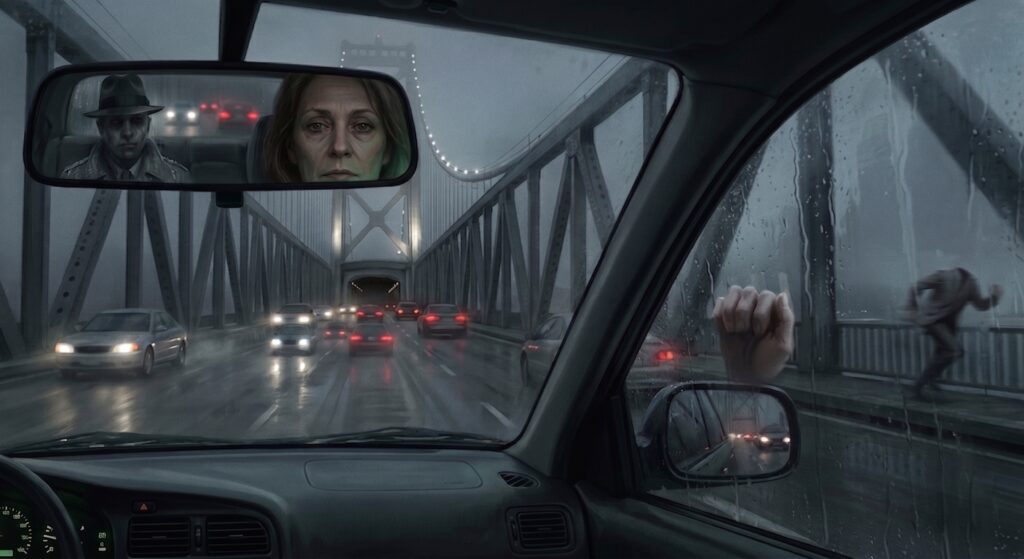
The bridge’s most consistent apparition wears a 1940s hat and raincoat. Legend pins his death to 1948. His car sputtered dry. He set off on foot to find a phone and call for a tow. He never came back. Traffic ended his walk somewhere along the span.
Drivers still meet him near the third tower on the northwest side, just before the tunnel. He behaves like a trick of the eye. In your peripheral vision he looks completely real, a solid man in a wet coat. Turn to look straight at him, and he vanishes. The direct gaze erases him every time.
Earthquake Trauma Wears a Disguise
The 1989 Loma Prieta earthquake tore a 50-foot section from the upper deck. The disaster left a scar the legends never let heal. Motorists began reporting back-seat hitchhikers and a headless man sprinting alongside cars at highway speed.
The headless runner carries a revealing flaw. Folklore casts him as a male victim. Records confirm the deck collapse killed a woman. The legend rewrote her. Local memory reshaped the tragedy to fit a grittier archetype. In doing so, it buried the actual person under a scarier costume.
The Knocking on the Glass
Not every haunting here stays visual. Commuters on the lower deck heading toward Oakland describe a tactile horror. Rhythmic knocking taps their car windows while they travel at full speed. Insistent. Patient. Impossible.
Why the Corner of the Eye Matters
The raincoat man always dies under a direct stare. That pattern is not random. Peripheral vision reacts to motion and shape faster than the focused center of the eye. It fills gaps with expectation. A tired commuter primed for a ghost may build one from headlights and shadow.
Reading the Ghosts as a Map of Grief
Stack these hauntings together and a pattern surfaces. The vanishing pedestrian, the rewritten runner, the knuckles on the glass, each one personifies a specific transit fear. Running out of gas alone at night. Dying in a sudden collapse. Sitting trapped in a car with something unseen.
The Grey Lady of the Commute
Locals sometimes call the span the Grey Lady, a nod to its industrial steel and its brooding mood. The nickname fits the hauntings. This is not a romantic bridge with a single tragic figure. It is a working machine that carries the anxieties of a whole region.
If You Want to Meet Him
The raincoat man keeps a reliable address. Aim for the northwest side near the third tower, just before the Yerba Buena tunnel. Have someone else drive it safely for you after dark. Do not stare. He lives in the corner of your eye, and hunting him head-on only sends him away.
References & Further Reading
Wikipedia, San Francisco-Oakland Bay Bridge: https://en.wikipedia.org/wiki/San_Francisco%E2%80%93Oakland_Bay_Bridge
USGS, 1989 Loma Prieta earthquake overview: https://earthquake.usgs.gov/earthquakes/eventpage/nc216859/executive
KQED, The Tale of the Bay Bridge Troll (span history): https://www.kqed.org/news/11892152/the-tale-of-the-bay-bridge-troll