The Marfa Lights viewing area is nine miles east of the town of Marfa on US Highway 67, and the Texas Department of Transportation built a designated turnout specifically for watching them. This is notable. It means that a state government agency has formally acknowledged that something worth watching happens in this stretch of Chihuahuan Desert often enough to justify parking infrastructure for observers.
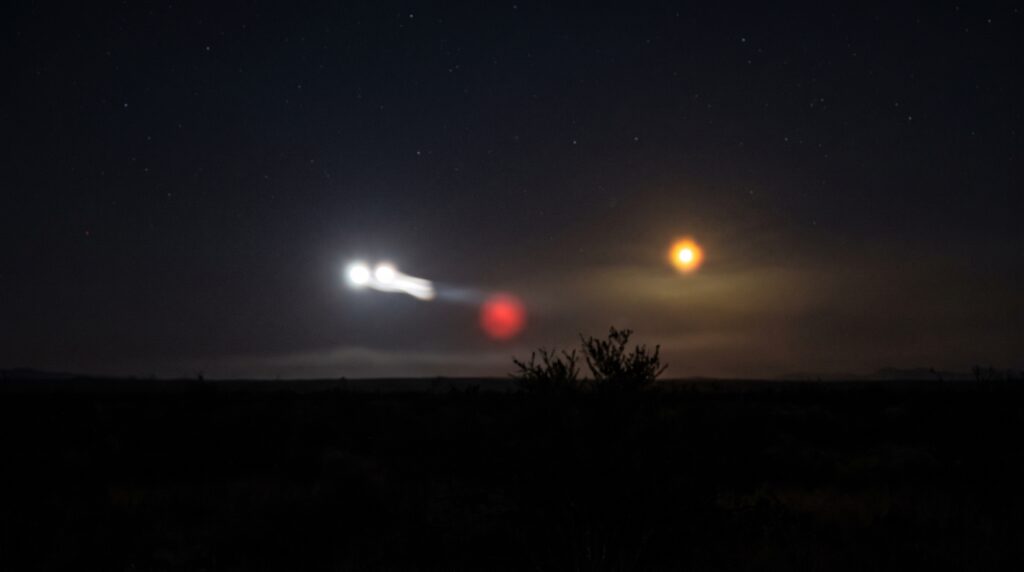
The Marfa Lights are not a cryptid in any standard sense. They have no physical form, no behavior pattern consistent with an animal, and no folklore tradition describing them as a creature. But they occupy the same psychological territory that cryptids occupy: they are genuinely unexplained, they are associated with a specific place, and they draw visitors who are motivated by the same curiosity that drives monster tourism. The relationship between anomalous lights and cryptid sightings in the same landscapes is an underexplored connection in paranormal geography.
The Lights and the Landscape
The Chihuahuan Desert around Marfa is extraordinary terrain: a high desert plateau at 4,500 feet, vast unobstructed sightlines to distant mountain ranges, almost no light pollution, and atmospheric conditions that produce remarkable optical effects, including mirage layers and light bending over temperature-stratified air. The University of Texas at Dallas conducted a 2004 study that attributed a significant portion of Marfa Lights observations to headlights from Highway 67, refracted and concentrated by atmospheric conditions to appear as mysterious orbs. The study was thorough and the explanation plausible for many sightings.
It does not explain historical accounts from before the automobile era. Additionally, the lights are described as splitting, merging, changing color, and behaving in ways that do not match any known optical mechanism, including Highway 67 headlight refraction. The most responsible assessment treats the conventional explanation as correct for a portion of documented Marfa Lights and genuinely unknown for another portion.
Why Strange Landscapes Generate Multiple Strange Stories
The Marfa Lights are part of a broader pattern in which landscapes that produce anomalous light phenomena also tend to generate cryptid reports, UFO sightings, and general accounts of high strangeness. The Hessdalen Valley in Norway generates both persistent light phenomena and occasional creature accounts. In the Hudson Valley of New York, a persistent Bigfoot tradition coexists with a UFO wave that peaked in the 1980s. The San Luis Valley in Colorado has documented reports of cattle mutilations, UFOs, and Bigfoot in the same landscape.
This co-location may reflect an underlying physical reality: certain geological and atmospheric conditions that produce anomalous lights may also disorient wildlife or affect human perception in ways that generate multiple categories of unusual encounter. Or it may reflect a social reality. Landscapes identified as strange attract the attention of investigators from multiple traditions, who notice the strange things their specific frameworks prepare them to see. The Marfa area around Big Bend, with its extraordinary geology and remoteness, is a place where multiple unusual things happen independently and where the cultural expectation of strangeness shapes how those things are reported.