Halved ping-pong balls over the eyes, red light on the face, static in the headphones. It looks absurd. Yet this exact setup became parapsychology’s best shot at proving telepathy in a laboratory, and the debate it started still has not ended.
The ganzfeld experiment is the field’s flagship. Understanding how it works and where it fails tells you a lot about how to weigh any paranormal claim.
What the Ganzfeld Is
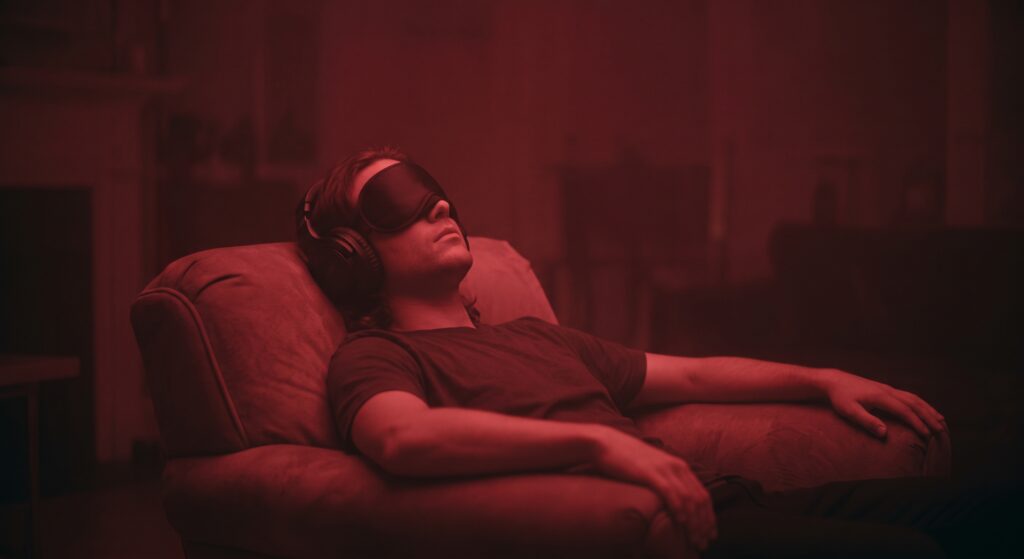
Ganzfeld is German for whole field. The method reduces sensory input to a smooth, featureless minimum. A receiver reclines in mild sensory deprivation, ping-pong halves over the eyes bathed in red light, and white or pink noise in the headphones.
The rationale is that spontaneous psychic experiences often occur in relaxed, altered states. The Ganzfeld tries to recreate those conditions on demand. Parapsychologists adopted it in the mid-1970s, and it has anchored the field ever since.
The Setup
A typical trial runs about thirty minutes. In another room, a sender focuses on a randomly chosen target image or clip and tries to transmit it mentally. The receiver speaks aloud, describing whatever impressions arise.
Afterward, the receiver views four options and picks which one the sender saw. By chance alone, they should be right one time in four, or twenty-five percent. Success rates above that baseline are what researchers point to as possible evidence.
Modern Ghost-Hunting Adaptations
Some investigators borrow the ganzfeld’s altered state for spirit communication rather than telepathy. The reasoning is that deep sensory reduction opens the mind to impressions it would normally filter out.
This crossover is worth flagging clearly. The original research targeted telepathy between living people, not contact with the dead. Repurposing the method for ghosts is a leap the science never made.
The Long Debate
The ganzfeld sparked a famous back-and-forth. Skeptic Ray Hyman and parapsychologist Charles Honorton dissected early studies and found flaws: weak randomization and possible sensory leakage between rooms. Honorton then ran tighter automated trials in response.
The honest summary is uncomfortable for both sides. Something small and persistent shows up in the data, yet it may be an artifact rather than genuine. Free-response descriptions also invite generous interpretation. Say you saw a house, and a house probably appeared somewhere in a thirty-minute clip.
From Lab Curiosity to Flagship
Charles Honorton helped move the ganzfeld to center stage after 1974. Early studies reported hit rates above the twenty-five percent baseline, and parapsychologists hailed the method as repeatable. That claim invited intense scrutiny, which is exactly what a strong scientific claim should invite.
Later meta-analyses pooled dozens of studies. Some found a small, persistent effect above chance. Others attributed it to lingering flaws in design and reporting. The disagreement never fully resolved, which is why the ganzfeld remains both the field’s best evidence and its most contested.
Would You Try It?
The ganzfeld remains fascinating precisely because it sits at the edge of what science can pin down. It shows how hard it is to design a clean experiment and how easily expectation shapes ambiguous results.
One caution: sensory deprivation can produce vivid imagery and, for some, real psychological intensity. Approach it gently. Would you be brave enough to try the setup in a place you already believe is haunted?
References & Further Reading
Ganzfeld experiment, Wikipedia
Ganzfeld ESP, Psi Encyclopedia